

Introduction
“Why have my periods suddenly changed when I have always been regular?”
That is often the question that brings women to perimenopause.
Sometimes it starts with a cycle that turns up a week early. Sometimes it is a period that is much heavier than usual. Sometimes it is not the periods at first at all, but broken sleep, irritability, anxiety, night sweats, or the unsettling feeling that your body is behaving differently and you cannot quite explain why.
Perimenopause can begin years before menopause itself. It is a transition, not a single event. The changes are real, biological, and often confusing because hormones do not decline in a neat, straight line. They fluctuate. That is why symptoms can feel inconsistent from month to month, and why many women wonder if what they are noticing is “normal,” stress, illness, or something else entirely. NHS guidance notes that symptoms can begin years before periods stop completely, and the first sign is often a change in the normal period pattern. (nhs.uk)
What is perimenopause?
Perimenopause is the phase leading up to menopause, when ovarian function becomes more variable and menstrual cycles start to change. You are still in perimenopause as long as you are having periods, even if they are irregular. Menopause is reached after 12 consecutive months without a menstrual period. (nhs.uk)
This transition often begins in the 40s, though timing varies. Some women notice changes earlier, and some later. Symptoms can last for several years. In practical terms, perimenopause is the body’s reproductive transition from consistently ovulating cycles to the final menstrual period. (Mayo Clinic)
Why does it happen?
Perimenopause happens because the ovaries age. Over time, the number and responsiveness of ovarian follicles decline. These follicles are the structures that contain immature eggs and help produce reproductive hormones. As ovarian reserve declines, hormone signalling becomes less predictable, ovulation becomes less consistent, and menstrual cycles become more variable. (PubMed)
This is why perimenopause is not simply “low oestrogen.” Early in the transition, oestrogen may at times still be normal or even temporarily high. What changes first is often the stability of the hormonal rhythm. Inhibin B and anti-Müllerian hormone decline as ovarian reserve falls, follicle-stimulating hormone rises in response, and cycle-to-cycle hormonal patterns become more erratic. (PubMed)
Hormonal and biological mechanisms
1. Ovulation becomes less reliable
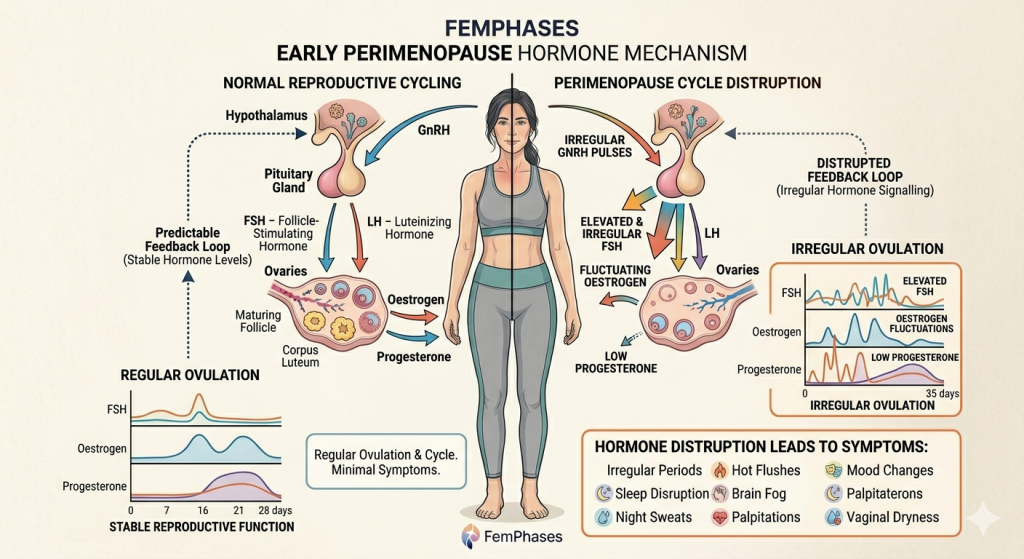
In a typical ovulatory cycle, the brain and ovaries communicate through a feedback loop involving follicle-stimulating hormone (FSH), luteinising hormone (LH), oestradiol, progesterone, and inhibin. As ovarian ageing progresses, this coordination becomes less steady. Some cycles still ovulate; some do not. (NCBI)
2. Progesterone often falls before oestrogen falls steadily
When ovulation is missed or weaker, the corpus luteum does not produce progesterone in the usual way. That matters because progesterone helps regulate the second half of the menstrual cycle and stabilise the endometrium, the lining of the womb. Lower or inconsistent progesterone can contribute to shorter cycles, spotting, heavier bleeding, or bleeding that feels “off pattern.” This is one reason cycle change is often the earliest clue. (nhs.uk)
3. Oestrogen fluctuates rather than simply dropping
Oestradiol can fluctuate from one cycle to the next. These fluctuations affect the brain, blood vessels, sleep regulation, temperature control, the vaginal and urinary tissues, and mood-related neurochemistry. Because the swings can be abrupt, symptoms may feel sudden or inconsistent. (Mayo Clinic)
4. The brain’s temperature regulation becomes more sensitive
Hot flushes and night sweats, often called vasomotor symptoms, are linked to changes in central thermoregulation associated with hypoestrogenism and menopausal transition. In simple terms, the brain becomes more likely to trigger heat-loss responses, such as flushing and sweating, to small changes in body temperature. (ScienceDirect)
5. Genital and urinary tissues become more oestrogen-sensitive
Lower and fluctuating oestrogen affects the vaginal and vulval tissues, which can become drier, thinner, more fragile, and less elastic. This can lead to irritation, vaginal dryness, discomfort during sex, and sometimes urinary urgency or recurrent urinary symptoms. (ACOG)
6. Sleep, mood, and cognition are affected through several pathways
Sleep may be disrupted directly by night sweats and indirectly by hormonal changes, the stress response, and mood. Problems with concentration or “brain fog” can be linked to poor sleep, vasomotor symptoms, mood symptoms, and hormonal shifts rather than a single cause. (nhs.uk)
Common signs, symptoms, or patterns
The first and most common early sign: changes in periods
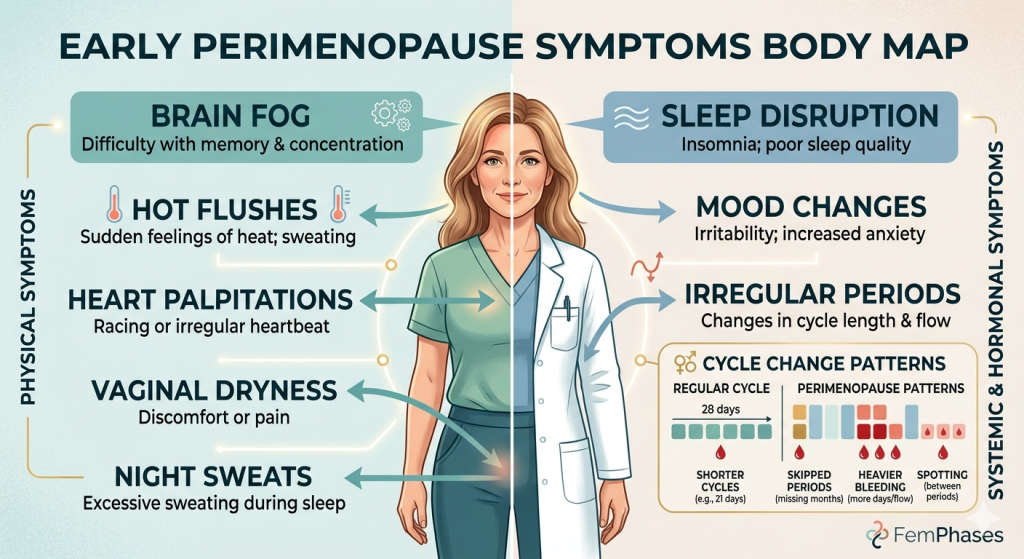
For many women, the earliest sign is a shift in menstrual pattern. This can include:
- periods coming closer together or further apart
- heavier or lighter bleeding
- longer or shorter periods
- skipped periods
- spotting around the cycle
- more unpredictable timing overall (nhs.uk)
A change in bleeding pattern is common in perimenopause, but it still matters. “Common” does not mean every bleeding change should be ignored. (ACOG)
Other early signs women may notice
Common symptoms reported in perimenopause include:
- hot flushes
- night sweats
- sleep disturbance
- mood swings, low mood, or increased anxiety
- memory or concentration difficulties
- vaginal dryness
- lower libido
- headaches
- palpitations
- joint aches or stiffness (nhs.uk)
Patterns that are especially typical
A very perimenopausal pattern is inconsistency. Symptoms may appear for one month, ease the next, then return. You may still have some completely normal cycles mixed in with more disrupted ones. Skipped periods can happen, and regular monthly bleeding may briefly return. (Mayo Clinic)
What is considered normal, and what is not Often considered normal in perimenopause.
These changes are commonly seen in the menopausal transition:
- irregular cycles
- occasional skipped periods
- periods that become lighter or heavier than before
- hot flushes or night sweats
- changes in sleep, mood, libido, and vaginal comfort (nhs.uk)
Not something to brush off
You should not assume all bleeding changes are “just hormones.” Bleeding needs medical review if you have:
- bleeding between periods
- bleeding after sex
- very heavy bleeding
- prolonged bleeding
- symptoms of anaemia, such as dizziness or marked fatigue
- bleeding after menopause, meaning any bleeding more than 12 months after your last period (nhs.uk)
Age-related red flags
Symptoms suggestive of menopause before age 45 deserve assessment, and symptoms under 40 raise concern for premature ovarian insufficiency or early menopause, which is managed differently and has longer-term implications for bone and cardiovascular health. (NHS inform)
Common causes, triggers, or contributing factors
Perimenopause itself is driven by ovarian ageing, but symptoms are often shaped by other factors too.
1. Irregular ovulation
This is the central driver of early cycle changes and hormone instability. (PubMed)
2. Stress and poor sleep
Stress does not “cause” perimenopause, but it can worsen sleep, anxiety, palpitations, irritability, and the ability to cope with vasomotor symptoms. Sleep disruption can also intensify mood symptoms and brain fog. This overlap is one reason perimenopause can be mistaken for burnout or vice versa. (LWW Journals)
3. Midlife health changes
Weight gain, insulin resistance, thyroid disease, depression, anxiety, uterine fibroids, and changing medication use may affect how symptoms present or how they are interpreted. Some of these conditions can also cause abnormal bleeding or changes in mood and energy on their own. (PMC)
4. Smoking and earlier timing
Smoking is a known factor associated with earlier menopause, so that smokers may notice transition symptoms earlier. (NCBI)
5. Surgery or medical treatment
Ovarian surgery, chemotherapy, pelvic radiation, or certain medical conditions can reduce ovarian function and bring on symptoms earlier. Premature ovarian insufficiency is one example and needs proper medical assessment. (ACOG)
Related conditions that may be confused with First Signs of Perimenopause
Not every symptom in your late 30s or 40s is perimenopause. Important overlaps include:
1. Thyroid disease
Both underactive and overactive thyroid disease can affect periods, energy, mood, temperature tolerance, and sleep. Thyroid dysfunction is also a recognised systemic cause of abnormal uterine bleeding. (PMC)
2. Pregnancy
If periods become irregular, pregnancy can still happen in perimenopause as long as ovulation still occurs some of the time. Pregnancy should remain on the list if periods are late or unusual. (ACOG)
3. Depression and anxiety disorders
Low mood, anxiety, poor concentration, sleep changes, and irritability may overlap strongly with perimenopause, and the two can coexist. (nhs.uk)
4. Iron deficiency
Heavy or prolonged bleeding can lead to iron deficiency, which may cause fatigue, dizziness, headaches, shortness of breath, and poor concentration. (nhs.uk)
5. Fibroids, polyps, adenomyosis, or endometrial problems
These may cause heavy bleeding, prolonged bleeding, pain, or bleeding between periods. Perimenopause does not rule these out. (Contemporary OB/GYN)
6. Primary ovarian insufficiency
This is different from the usual menopausal transition because it occurs before age 40 and is considered a medical condition, not just a normal timing variation. (NCBI)
7. Genitourinary infections or sexually transmitted infections
Vaginal irritation, urinary symptoms, and bleeding after sex may be due to dryness and hormonal tissue changes, but infection and cervical causes should also be considered. (nhs.uk)
How age, life stage, stress, sleep, lifestyle, or medical conditions may affect it
1. Age and life stage
Most women begin noticing perimenopausal changes in their 40s, but the exact timing varies. Symptoms before 45 warrant assessment, especially if the change feels abrupt or periods have stopped for several months. (NHS inform)
2. Stress
Stress can amplify the experience of symptoms. It can worsen sleep fragmentation, increase sensitivity to hot flushes, heighten anxiety, and make cognitive symptoms feel more intense. Stress may not be the root cause, but it often shapes severity. (LWW Journals)
3. Sleep
Sleep disturbance is both a symptom and a symptom multiplier. Night sweats may wake you directly, while hormone shifts and mood changes may reduce sleep quality. Poor sleep then feeds fatigue, irritability, cravings, pain sensitivity, and brain fog. (LWW Journals)
4. Lifestyle
Smoking is associated with earlier menopause. Weight changes and reduced physical activity may also influence symptom burden, metabolic health, and the body’s experience of midlife hormone shifts. (NCBI)
5. Medical conditions and medicines
Contraception, antidepressants, thyroid disease, PCOS history, fibroids, chronic stress, obesity, and previous cancer treatments can all change the picture. This is one reason diagnosis relies on the full story, not a single symptom. (NICE)
What can help or what to do next
1. Track the pattern
Keep a simple record of:
- cycle dates
- bleeding heaviness
- spotting
- hot flushes or night sweats
- sleep quality
- mood changes
- vaginal or urinary symptoms
- headaches, palpitations, or other recurring changes
Pattern-tracking helps distinguish random bad weeks from a true hormonal shift, giving your clinician something concrete to work with.
2. Think in symptom clusters, not isolated symptoms
One odd period alone is not always meaningful. But irregular bleeding plus night sweats plus disrupted sleep plus vaginal dryness paints a more recognisable picture.
3. Support sleep and nervous system stability
Practical basics can make a real difference:
- regular sleep and wake times
- a cool bedroom if night sweats are an issue
- moderating alcohol if it worsens flushing or sleep
- managing caffeine if it worsens palpitations or anxiety
- physical activity that supports mood and sleep
- stress-reduction strategies that are realistic, not punishing
4. Get help early if symptoms are affecting life
NHS guidance encourages seeking advice early because symptoms can affect work, relationships, and quality of life. A GP, nurse, or pharmacist may all be part of first-line support. (nhs.uk)
5. Know that diagnosis is often clinical
For women over 45 with typical symptoms, NICE says perimenopause is usually identified from symptoms and menstrual changes, and routine hormone tests such as AMH, inhibin, oestradiol, and ovarian scans should not be used to identify it. A single hormone test can be misleading because levels fluctuate too much. (NICE)
6. Consider treatment if symptoms are significant
Management depends on symptoms, age, medical history, contraception needs, and personal preference. Options may include lifestyle measures, non-hormonal symptom support, vaginal oestrogen for genitourinary symptoms, or systemic hormone therapy where appropriate. NICE’s updated guidance includes recommendations for genitourinary symptoms and states vaginal oestrogen can be offered and continued for as long as needed for symptom relief. (The Menopause Charity)
When to speak to a doctor
Speak to a doctor, GP, nurse, or menopause-aware clinician if:
- Symptoms are troubling you or affecting daily life
- you think symptoms are starting before age 45
- you are under 40 and think menopause may be happening
- your bleeding is very heavy, prolonged, between periods, or after sex
- you may be anaemic, dizzy, very fatigued, or short of breath
- you have any bleeding after 12 months without periods
- symptoms are unclear and you are not sure whether another condition may be involved (NHS inform)
Seek urgent help for very heavy bleeding, especially if you are soaking pads or tampons rapidly, feel faint, or have symptoms of significant blood loss. (Mayo Clinic)
Common myths and misunderstandings
Myth 1: “The first sign is always hot flushes.”
Not necessarily. The first sign is often a change in period pattern, not vasomotor symptoms. (nhs.uk)
Myth 2: “If I still have periods, it cannot be perimenopause.”
False. Perimenopause happens while periods are still occurring, just less predictably. Menopause is only diagnosed after 12 months without a period. (nhs.uk)
Myth 3: “A blood test will tell me for sure.”
Usually not. In women over 45 with typical symptoms, diagnosis is usually based on symptoms and cycle changes because hormone levels fluctuate too much for a single test to be definitive. (NICE)
Myth 4: “Heavy or unusual bleeding is normal in midlife, so I should just wait it out.”
Some bleeding change is common, but bleeding between periods, after sex, very heavy bleeding, prolonged bleeding, or bleeding after menopause needs assessment. (nhs.uk)
Myth 5: “It is all just stress.”
Stress can absolutely worsen symptoms, but it does not explain away the real hormonal transition. Both things may be true at once. (LWW Journals)
Myth 6: “You cannot get pregnant during perimenopause.”
Pregnancy is still possible while ovulation continues, even if cycles are irregular. (ACOG)
Key takeaway
The first signs of perimenopause are often subtle but meaningful. For many women, the earliest clue is not a dramatic hot flush but a period that no longer behaves like it used to. Underneath that change is a real biological transition: ovarian follicles are becoming less responsive, ovulation is less consistent, progesterone often becomes more erratic, and oestrogen starts to fluctuate in ways that affect the whole body. That is why early perimenopause can show up as bleeding changes, sleep disruption, mood shifts, brain fog, hot flushes, vaginal dryness, or all of them in a scattered, unpredictable pattern. Most importantly, common does not mean you have to put up with it; not every symptom should be assumed to be hormonal. Clear information, symptom tracking, and medical review when needed can turn a confusing phase into one that feels much more understandable and manageable. (nhs.uk)
FAQs
1. What is usually the very first sign of perimenopause?
Usually, it is a change in the normal pattern of periods. They may become irregular, heavier, lighter, closer together, or more widely spaced. (nhs.uk)
2. Can perimenopause start before 40?
It can, but that is not considered typical perimenopause timing. Symptoms under 40 raise concern for premature ovarian insufficiency and should be assessed. (NCBI)
3. Why do periods get heavier in perimenopause?
A common reason is irregular ovulation and lower or inconsistent progesterone, which can lead to less stable control of the womb lining. But fibroids, polyps, adenomyosis, thyroid disease, and other causes also need to be considered. (ACOG)
4. Can you be in perimenopause and still have regular periods sometimes?
Yes. Cycles can be mixed during the transition. You may have irregular months and then a few seemingly normal cycles again. (Mayo Clinic)
5. Do I need a hormone blood test to confirm perimenopause?
Usually not if you are over 45 and have typical symptoms. NICE advises against using several routine hormone tests to identify perimenopause in this group because results can be misleading. (NICE)
6. Can anxiety be an early sign of perimenopause?
Yes. Mood changes, anxiety, and low mood are commonly reported in perimenopause, though they can also overlap with life stress and mental health conditions. (nhs.uk)
7. Is brain fog a real perimenopause symptom?
Yes. Problems with memory or concentration are commonly reported. Sleep disturbance, night sweats, mood symptoms, and hormonal changes may all contribute. (nhs.uk)
8. When should I worry about bleeding changes?
Seek medical assessment if you have bleeding between periods, after sex, very heavy bleeding, prolonged bleeding, or any bleeding after menopause. (nhs.uk)
9. Can you still get pregnant in perimenopause?
Yes. As long as ovulation still happens, pregnancy is still possible, even if cycles are irregular. (ACOG)
10. How long does perimenopause last?
It varies. For many women, it lasts several years, and symptoms may begin years before periods stop completely. (nhs.uk)
Medical Disclaimer
This article is for educational purposes only and is not a substitute for personal medical advice, diagnosis, or treatment. If you have concerning symptoms, heavy or unusual bleeding, severe pain, or questions about perimenopause, please speak to a qualified healthcare professional.