Femphases

FemPhases Editorial Team

Oestrogen Dominance: 12 Signs Your Progesterone Is Too Low

Table of Contents Introduction Why this happens: the hormone mechanism in plain English 12 signs your progesterone may be too low What else can look similar? Evidence-based solutions Medical interventions Holistic and lifestyle support When to see a doctor Frequently Asked Questions Disclaimer Introduction If you have been feeling unlike yourself lately, you are not imagining it. Many of us notice changes in our cycles, mood, sleep, breasts, skin, or energy and wonder whether our Hormone Health is shifting underneath it all. When people use the phrase “oestrogen dominance,” they are usually describing a pattern where oestrogen’s effects feel stronger because progesterone is too low, especially in the second half of the cycle or during perimenopause. Strictly speaking, oestrogen dominance is not a formal medical diagnosis, but the symptoms people mean by it can be very real and deserve proper assessment. (The Menopause Consortium) In this guide, we will walk through 12 common signs that progesterone may be too low, explain the biology in clear language, and cover both evidence-based medical options and supportive lifestyle steps to help you feel steadier, more informed, and in control of your Hormone Health. We will also cover the important red flags that should not be brushed aside. Oestrogen Balance Self Assessment Why this happens: the hormone mechanism in plain English Oestrogen and progesterone are not “good” and “bad” hormones. They are a team. Oestrogen helps build up the uterine lining and plays a role in bone health, brain function, skin, and metabolism. Progesterone rises after ovulation and helps balance that build-up, stabilise the lining, and prepare the body for a possible pregnancy. (Cleveland Clinic) When you do not ovulate regularly, you may not make enough progesterone. That can happen in perimenopause, with some cases of PCOS, during times of major stress, after significant weight change, with thyroid issues, or when cycles become irregular for other reasons. The result is not always “too much oestrogen” in an absolute sense. Often, there is too little progesterone relative to oestrogen’s effects. (Endocrine) This matters because progesterone helps keep the uterine lining from being overstimulated. Without enough progesterone, some people develop heavier periods, more spotting, breast tenderness, bloating, and cycle-related mood changes. In menopause care, this is also why people with a uterus who take systemic oestrogen usually need a progestogen alongside it to protect the endometrium. (NICE) So if your Hormone Health feels off, the issue may not be a trendy hormone label. It may be a very understandable pattern of ovulation changes, low progesterone, changing cycle signals, or a separate gynaecological condition that needs treatment. 12 signs your progesterone may be too low Below are the symptoms many women describe when they talk about “oestrogen dominance.” None of these signs proves a diagnosis on its own, but together they can paint a useful picture. Heavy periods If you are soaking through pads or tampons faster than usual, passing clots, or finding your periods are disrupting work, sleep, or daily life, low progesterone can be part of the story because the uterine lining may be less well-regulated. Heavy bleeding is not considered normal and deserves assessment. (acog.org) Shorter cycles or more frequent periods Some women notice their cycle shortening, for example, from 28 days to 24 or 21 days. This can happen when ovulation becomes less predictable and progesterone support in the second half of the cycle drops. (acog.org) Spotting before your period Brown spotting or light bleeding in the days leading up to a period can sometimes indicate a weaker luteal phase, meaning progesterone may not stay high enough for long enough. (Endocrine) Breast tenderness or swollen breasts Sore, full, or lumpy-feeling breasts often get worse when hormonal balance is shifting. Breast tenderness is commonly reported with hormone fluctuations and can be especially noticeable in perimenopause. (nhs.uk) Bloating and fluid retention Feeling puffy, swollen, or uncomfortable around your abdomen can show up when hormones fluctuate, especially in the premenstrual phase. (nhs.uk) Worse PMS If the week or two before your period feels like a completely different version of you, progesterone may be part of the picture. PMS can include mood symptoms, breast pain, headaches, bloating, irritability, and food cravings. (nhs.uk) Mood swings, anxiety, or feeling emotionally less resilient Hormonal fluctuations can affect neurotransmitters and sleep, which, in turn, can affect mood. During the menopausal transition, mood changes and anxiety are common enough that NICE specifically recommends considering menopause-focused CBT for some women. (nhs.uk) Sleep problems You may feel wired at night, wake often, or sleep lightly in the days leading up to your period. Sleep can worsen during times of hormonal change, particularly in perimenopause and menopause. (nhs.uk) Headaches or menstrual migraines Hormone fluctuations, especially around the late luteal phase and period, can trigger headaches in some women. (nhs.uk) Lower libido Low progesterone is not the only cause of low desire, but shifting sex hormones, fatigue, stress, sleep loss, and mood changes can all feed into reduced libido. (Cleveland Clinic) Irregular ovulation or fertility struggles Progesterone rises after ovulation, so if you are not ovulating regularly, progesterone may remain low. That can affect cycle predictability and make conception harder. (Endocrine) Symptoms worsening in perimenopause For many women, this pattern becomes more obvious in their 40s because ovulation becomes more erratic before periods stop completely. Perimenopause can bring irregular bleeding, breast tenderness, sleep disruption, mood changes, and cycle unpredictability. (acog.org) What else can look similar? This is an important Hormone Health point: symptoms that get blamed on “oestrogen dominance” may actually be caused by something else. Heavy or irregular bleeding can also happen with fibroids, adenomyosis, endometrial polyps, thyroid problems, PCOS, pregnancy-related issues, medication effects, or endometrial changes. Fibroids in particular can cause heavy bleeding, pelvic pain, and pressure symptoms. (acog.org) That is why we should be cautious about self-diagnosing based solely on social media. A proper history and examination, and sometimes blood tests, cervical screening review, ultrasound, or endometrial assessment, may be needed depending on your age and symptoms. (acog.org) Hormonal Imbalance in Women:

Oestrogen Dominance: 12 Signs Your Progesterone Is Too Low Read More »

Perimenopause vs. Menopause: The 10-Year Transition No One Explains

Table of Contents The part nobody prepares us for Perimenopause vs menopause: what is the difference? Why does this happen: the hormone changes behind the symptoms Symptoms you might notice during the transition What can help: evidence-based treatment options Medical interventions Lifestyle and holistic support When to see a doctor Expert FAQ Final thoughts The part nobody prepares us for Menopause is often talked about as if it is one single moment. One day you are “fine,” and the next day you have crossed some invisible line into a new stage of life. But for most of us, that is not how it unfolds at all. What many women actually live through is a long, confusing transition that can stretch over several years. Periods change. Sleep changes. Mood changes. Your body can start to feel unfamiliar before you have missed enough periods even to be called “in menopause.” That experience is real, common, and deeply under-explained. (nhs.uk) In this guide, we will walk through the difference between perimenopause and menopause, why symptoms can begin years earlier than expected, what is happening hormonally, what treatments are backed by evidence, and when symptoms should not be brushed off. The goal is simple: to help us understand what our bodies are doing, so we can respond with clarity instead of confusion. (nhs.uk) Perimenopause vs menopause: what is the difference? a. Perimenopause Perimenopause is the transition leading up to menopause. During this phase, the ovaries gradually become less consistent in releasing eggs and producing hormones, especially oestrogen and progesterone. It often begins in the 40s, but timing varies. ACOG notes that perimenopause may last from about ages 45 to 55, although some women notice changes earlier. (ACOG) This is why many women say, “I do not feel like myself anymore,” even while they are still having periods. You can absolutely be in perimenopause while still menstruating. In fact, irregular or changing periods are often one of the earliest signs. (nhs.uk) b. Menopause Menopause is not the whole transition. It has a specific medical definition: the point when you have gone 12 months in a row without a menstrual period. After that point, you are considered postmenopausal. (nhs.uk) That distinction matters. Perimenopause is the lead-up. Menopause is the milestone. Post menopause is what comes after. Perimenopause Symptom Checker Why it feels like a “10-year transition” People often describe this as a decade-long shift because symptoms may begin years before the final period and persist afterwards. NHS and NIH guidance both note that symptoms can start years before periods stop and may carry on beyond that point. (nhs.uk) Whydoes this happen: the hormone changes behind the symptoms This is the part we deserve to have explained clearly. During the reproductive years, oestrogen and progesterone rise and fall in a more predictable rhythm. In perimenopause, that rhythm becomes less steady. The ovaries start working less reliably, ovulation becomes more irregular, and hormone levels fluctuate more dramatically. That hormonal unpredictability is what drives so many of the symptoms. (ACOG) Oestrogen affects much more than periods. It interacts with the brain, blood vessels, bones, bladder, vagina, skin, sleep regulation, and temperature control. So when oestrogen swings up and down, it can show up as hot flushes, night sweats, anxiety, low mood, sleep disruption, vaginal dryness, joint discomfort, and brain fog. (nhs.uk) Progesterone also changes. Because ovulation becomes less predictable, progesterone can drop unevenly as well. That can contribute to cycle changes, sleep disruption, and a general sense that your body is no longer running on the patterns you knew for years. This is also why one blood test often does not “capture” what is happening. NICE advises that in people aged 45 or over with typical symptoms, menopause and perimenopause are usually diagnosed based on symptoms and menstrual history rather than broad hormone testing. (NICE) Symptoms you might notice during the transition The symptoms of menopause and perimenopause can be physical, emotional, cognitive, and sexual. They also vary widely. Some women have a few mild symptoms. Others feel as though every system in their body has changed at once. NHS, ACOG, and NIH sources describe a broad symptom pattern that can include: (nhs.uk) Irregular periods Heavier or lighter bleeding than usual Hot flushes Night sweats Sleep problems or waking at 3 a.m. for no obvious reason Mood changes, including irritability, anxiety, or low mood Brain fog, poor concentration, or forgetfulness Reduced libido Vaginal dryness Pain during sex Urinary symptoms, including urgency or recurrent discomfort Palpitations Headaches Aches, stiffness, or joint discomfort Changes in body composition or weight distribution Low confidence or a sense of not feeling like yourself None of this means you are failing to cope. It means the transition is affecting real biology. What can help: evidence-based treatment options There is no single “right” way to move through menopause. Treatment should be based on symptoms, medical history, personal preference, and what matters most in your daily life. NICE recommends individualised menopause care and shared decision-making rather than a one-size-fits-all approach. (NICE) A. Medical interventions i. Hormone replacement therapy (HRT) For many women, HRT is the most effective treatment for vasomotor symptoms such as hot flushes and night sweats. NICE recommends offering HRT for menopause-related vasomotor symptoms, and ACOG describes hormone therapy as a standard treatment option for several common symptoms. (NICE) HRT may also help with: Sleep disrupted by hot flushes Vaginal dryness and discomfort Mood symptoms linked to the transition Bone protection in some women, especially when menopause happens early (ACOG) There are different forms: Oestrogen-only HRT is usually used if you no longer have a uterus. Combined oestrogen and progestogen HRT is used if you still have a uterus, because oestrogen alone can thicken the uterine lining and raise endometrial cancer risk (ACOG) Transdermal options, such as patches or gels, may be preferred in some people because the route of administration can affect clotting risk. ACOG notes that oral oestrogen may have a more prothrombotic effect than transdermal oestrogen. (ACOG) ii. Vaginal oestrogen If

Perimenopause vs. Menopause: The 10-Year Transition No One Explains Read More »

Can You Get Pregnant on Your Period? The Truth About Cycle Days and Fertility

Table of Contents Introduction: Why This Question Matters Can You Get Pregnant on Your Period? Why It Can Happen: The Biology Behind Fertility and Cycle Days What You Might Notice in Your Body When Pregnancy Risk Is Higher During or Around a Period Evidence-Based Solutions if You Do Not Want Pregnancy Evidence-Based Support if You Are Trying to Conceive When to See a Doctor Expert FAQ Disclaimer Introduction: Why This Question Matters Many of us have asked this quietly at some point: Can you get pregnant on your period? It is such a common question because real life does not always follow the neat textbook version of a 28-day cycle. Periods can be shorter, longer, lighter, heavier, earlier, later, and sometimes completely unpredictable. That is exactly why understanding fertility matters so much. The short answer is yes, pregnancy during your period is possible, even if it is usually less likely than at other times in the cycle. In this guide, we will walk through why it can happen, how cycle days really work, what signs to watch for, when to take a pregnancy test, and what to do if you want to avoid pregnancy or improve your fertility awareness. (nhs.uk) Ovulation Calculator  Can You Get Pregnant on Your Period? Yes. You can get pregnant from sex during your period, especially if you have a short cycle, bleed for several days, or ovulate earlier than expected. The reason is simple: sperm can stay alive inside the reproductive tract for several days, and if ovulation happens soon after bleeding ends, those sperm may still be there when an egg is released. (Mayo Clinic) For many people, pregnancy is less likely in the heaviest early days of a period, but it is not impossible. That is why period sex should never be treated as reliable birth control. It also does not protect against sexually transmitted infections (STIs). (Planned Parenthood) Why It Can Happen: The Biology Behind Fertility and Cycle Days a. How the menstrual cycle really works A menstrual cycle starts on Day 1 of your period. Ovulation usually happens about 12 to 16 days before your next period starts, not always on Day 14. That distinction matters because many people do not ovulate in the middle of the month, and cycle lengths vary a lot from person to person. (nhs.uk) In a typical cycle, your body prepares an egg, releases it at ovulation, and thickens the uterine lining in case pregnancy happens. If the egg is not fertilised, hormone levels fall, and the lining sheds, resulting in a period. Fertility is highest in the few days before ovulation and the day of ovulation itself. (ACOG) b. Why period sex can still lead to pregnancy The key reason is sperm survival. Sperm can live in the female reproductive tract for about 3 to 5 days, and some guidance notes it may be up to 7 days in certain circumstances. The egg itself only survives for around 12 to 24 hours after ovulation. That means the fertile window opens before ovulation, not just on the day an egg is released. (Mayo Clinic) So imagine this: you have sex on the last day of your period, your cycle is short, and you ovulate soon after. Even though you were bleeding when you had sex, sperm may still be present when ovulation happens. That is how pregnancy can happen during what feels like a “safe” time. (nhs.uk) Who is more likely to be at risk? Pregnancy risk from sex during a period may be higher if you: Have short menstrual cycles Have irregular periods Bleed for more days Mistake spotting for a true period Ovulate early or unpredictably Are in the years after menarche or during times of hormonal change, when cycles can be less predictable (ACOG) Irregular cycles can happen for many reasons, including stress, thyroid problems, PCOS, major weight changes, intense exercise, and some forms of hormonal contraception. That unpredictability makes calendar-based assumptions about fertility less reliable. (nhs.uk) What You Might Notice in Your Body Most people do not feel a clear biological sign that sperm are surviving or that conception has happened right away. But there are clues that your cycle may be less predictable than you think. Signs you may be noticing Short cycles, where one period starts fewer than 21 days after the previous one Irregular timing, with cycle lengths changing noticeably month to month Bleeding that lasts longer than 7 days Mid-cycle spotting, which can be mistaken for a period Ovulation-type cervical mucus, often clear, slippery, or stretchy Mild one-sided pelvic discomfort around ovulation Breast tenderness, bloating, or increased libido around fertile days Anxiety after unprotected sex during bleeding, especially if your cycles are unpredictable (ACOG) If pregnancy does occur, early symptoms may include: A missed period Nausea Breast changes Fatigue Light implantation-type spotting Needing to urinate more often These symptoms are not specific, and they can overlap with PMS. A pregnancy test is usually the clearest next step once enough time has passed. (nhs.uk) Safe Days Calculator When Pregnancy Risk Is Higher During or Around a Period 1. If your cycle is short If your cycle is closer to 21-24 days rather than 28 days, ovulation can occur earlier. That narrows the gap between the end of your period and your fertile window. (ACOG) 2. If your bleeding lasts many days A longer bleed means intercourse during the “period” may happen closer to ovulation than you realise. With sperm survival added to the picture, fertility risk can overlap with bleeding days. (Mayo Clinic) 3. If your cycles are irregular When your periods are unpredictable, it becomes harder to estimate ovulation. That makes “cycle day math” less dependable. (nhs.uk) 4. If what seemed like a period was actually spotting Not all bleeding is a true menstrual period. Spotting can happen around ovulation, with hormonal shifts, or with other gynaecologic issues. If bleeding is unusual for you, you may not actually be on your period at all. (ACOG) Evidence-Based Solutions

Can You Get Pregnant on Your Period? The Truth About Cycle Days and Fertility Read More »

AMH and Fertility: What Low or High AMH Really Means

Introduction If you’ve had a fertility blood test and your AMH result has left you anxious, you’re not alone. A lot of women search for AMH and fertility because they want one simple answer: Does this result mean I can or cannot get pregnant? That question matters, especially when you are trying to conceive, thinking about waiting, or feeling unsettled by a number on a lab report. The truth is that AMH can give useful information, but it does not tell the whole story. Quick answer: AMH is a hormone that helps estimate your ovarian reserve, which means the number of eggs remaining in your ovaries. It can help doctors understand how your ovaries may respond to fertility treatment, but it does not reliably predict whether you can get pregnant naturally right now. Age, ovulation, egg quality, sperm health, and your overall reproductive health still matter a great deal. (ACOG) What is it? AMH stands for anti-Mullerian hormone. It is made by small follicles in the ovaries. Because those follicles contain immature eggs, AMH is often used as a marker of ovarian reserve. In plain English, it gives a rough idea of how many eggs are left compared with what is expected for your age. (Cleveland Clinic) What does AMH tell you? AMH and fertility are linked mainly through ovarian reserve. A higher AMH level usually suggests a higher number of remaining eggs, while a lower AMH level usually suggests fewer remaining eggs. (Cleveland Clinic) What AMH cannot tell you? This is the part many women are not told clearly enough: AMH does not measure egg quality, and it does not reliably predict whether you will get pregnant naturally this month or next. ACOG advises that a single AMH level in women not already seeking fertility care should not be used to predict natural fertility or the exact timing of menopause. (ACOG) AMH Level Interpretation Guide Why doctors use it Doctors often use AMH as part of a bigger fertility picture, especially when planning IVF or other fertility treatment, because it can help predict how strongly the ovaries may respond to stimulation medicines. (ASRM) Why does it happen? AMH levels change because your ovarian reserve changes over time. Age is the main reason. AMH usually falls with age because the number of eggs in the ovaries naturally declines over time. That decline is normal. (MedlinePlus) Other things that may affect AMH 1. Higher AMH Higher AMH can sometimes be seen in women with PCOS, because the ovaries may contain more small follicles. A high result does not automatically mean better fertility. In some cases, it may point to ovulation problems rather than an advantage. (UHCW) 2. Lower AMH Lower AMH may happen with age, diminished ovarian reserve, certain medical conditions, or after treatments that affect the ovaries, such as some cancer treatments. It may also reflect that your egg supply is lower than average for your age. (Cleveland Clinic) One result never tells the full story. AMH and fertility should never be judged by a single number alone. Doctors usually consider your age, menstrual history, ultrasound findings, medical history, and, sometimes, other hormone tests. (ASRM) Signs or symptoms AMH itself does not usually cause symptoms. You cannot feel your AMH level. What women often notice instead are signs of an underlying issue that may sit alongside an abnormal AMH result. Possible signs that deserve attention periods that are very irregular or absent difficulty getting pregnant Symptoms of PCOS, such as acne, excess facial hair, or cycle irregularity a history of endometriosis, ovarian surgery, chemotherapy, or pelvic infections early signs of perimenopause, such as changing cycles or hot flushes in some women (ASRM) A normal cycle does not always mean a normal AMH. Some women with low AMH still have regular periods and may still ovulate. That is one reason AMH and fertility can feel confusing. A lower AMH does not automatically mean pregnancy is impossible. (ACOG) What is normal, and when to pay attention This is where many women want a neat chart, but AMH ranges vary by lab, test method, and age. That means a result should always be interpreted using the lab’s reference range and your personal situation. (ASRM) What is usually considered reassuring A result within the expected range for your age can be reassuring, but it still does not guarantee easy conception. Fertility depends on much more than ovarian reserve. (ACOG) When a low AMH matters more A low AMH deserves more attention if: a. You are over 35 Age and ovarian reserve together matter more than either one alone. (ACOG) b. You have been without success. If you are under 35, evaluation is generally recommended after 12 months of trying. If you are 35 or older, it is recommended after 6 months. If you are over 40, or you have known issues such as irregular periods, endometriosis, or previous ovarian surgery, it is reasonable to seek help sooner. (ASRM) c. Your periods are irregular. AMH and fertility should be assessed alongside regular ovulation. Irregular periods may matter more than the AMH number alone. (ASRM)   When a high AMH matters more A high AMH may need follow-up if you have symptoms of PCOS or if fertility treatment is being planned, because it can be linked to a stronger ovarian response to stimulation. (UHCW) When to speak to a doctor Speak to a doctor, gynaecologist, or fertility specialist if: a. You are worried about a result. A doctor can explain what your AMH means in the context of your age and health, not just as a standalone number. b. You have been trying to conceive. under 35: after 12 months 35 or older: after 6 months over 40: don’t wait too long to ask for advice (ASRM) You have other red flags. Seek medical advice sooner if you have: irregular or absent periods known PCOS or endometriosis recurrent miscarriage past ovarian surgery previous chemotherapy or radiation severe pelvic pain or other symptoms that suggest a

AMH and Fertility: What Low or High AMH Really Means Read More »

Signs of Endometriosis You Should Not Ignore: Symptoms That Need Attention

Introduction If you have been wondering whether your painful periods, pelvic pain, or bowel symptoms could be signs of endometriosis, you should not ignore them; you are not overreacting. Many women are told that severe period pain is “just part of being a woman,” but ongoing pain that disrupts your life deserves proper attention. Endometriosis can look different from one person to another. For some women, it shows up as worsening period pain. For others, it appears as pain during sex, bowel pain, fatigue, or trouble getting pregnant. Quick answer: The main signs of endometriosis you should not ignore are pain that is severe, recurring, or starts interfering with daily life. This can include painful periods, pelvic pain between periods, pain during sex, painful bowel movements, pain when urinating during your period, heavy bleeding, and fertility difficulties. Endometriosis is treatable, but it should be evaluated by a doctor rather than dismissed. (nhs.uk) What is Endometriosis? Endometriosis is a condition in which tissue similar to the lining of the womb grows outside the womb, often on organs such as the ovaries, fallopian tubes, bowel, bladder, or pelvic lining. This tissue still responds to hormones, which means it can cause inflammation, irritation, scarring, and pain. (nhs.uk) Why Endometriosis matters Endometriosis is not simply “bad period pain.” It is a long-term condition that can affect physical health, emotional well-being, sex life, work, sleep, and fertility. NICE also notes that people with endometriosis may need long-term support because the impact can be wide-ranging. (NICE) Why does Endometriosis happen? The exact cause is not fully understood. It likely develops through a mix of factors rather than one single reason. These may include hormones, immune system factors, family history, and the way endometrial-like tissue can grow outside the womb. (ACOG) Trying to Conceive After 35: What Changes and What Doesn’t A few things doctors do know Hormones play a role. Endometriosis tissue responds to hormones such as estrogen, which can help explain why symptoms often flare around the menstrual cycle. (ACOG) It can run in families. A family history can increase suspicion, which is why NICE recommends asking about it when endometriosis is being considered. (NICE) Symptoms do not always match severity. Some women with significant endometriosis have mild symptoms, while others with smaller areas of disease may have severe pain. That is one reason symptoms should be taken seriously, even when scans are normal, or the pain seems hard to explain. Signs or symptoms The biggest message here is simple: the signs of endometriosis you should not ignore are the ones that keep happening, get worse, or start affecting your daily life. Common signs of endometriosis you should not ignore Very painful periods that stop you from doing normal activities Pelvic pain before, during, or after your period Heavy periods or bleeding that feels hard to manage Pain during or after sex, often felt deep inside Painful bowel movements during your period Pain when urinating during your period Lower back pain or ongoing pelvic ache Bloating, bowel discomfort, or intestinal pain Fatigue alongside recurring pain Difficulty getting pregnant or fertility concerns (nhs.uk) Symptoms that are easy to dismiss Some signs of endometriosis you should not ignore do not always look obviously “gynaecological.” For example: Bowel symptoms around your period If you notice pain when opening your bowels, constipation, diarrhoea, or deep pelvic pressure that gets worse around your period, that pattern matters. (Office on Women’s Health) Bladder pain during your period Pain when passing urine during menstruation can also be part of the picture and should not be brushed off. (Office on Women’s Health) Pain that keeps returning Pain that comes back month after month, especially if it is getting worse, is one of the clearest signs of endometriosis you should not ignore. (nhs.uk) Cramping in Early Pregnancy: What Is Normal and What Is Not? What is normal, and when to pay attention A mild amount of cramping that improves with rest, heat, or simple pain relief can happen with periods. But pain is not “normal” when it regularly disrupts your life. What may be within the usual range Mild cramps for a day or two Symptoms that respond well to simple pain relief Discomfort that does not stop you from functioning When to pay attention The signs of endometriosis you should not ignore usually involve a pattern like this: You miss work, school, or social plans because of period pain Pain relief is no longer helping enough Your symptoms are getting worse over time Sex becomes painful You have bowel or bladder pain linked to your cycle You feel exhausted by your periods every month You have been trying to conceive without success and also have painful periods or pelvic pain (nhs.uk) A medically responsible reminder Severe pain should not be self-diagnosed as endometriosis. Other conditions can also cause pelvic pain or heavy bleeding, including fibroids, pelvic inflammatory disease, adenomyosis, ovarian cysts, or bladder and bowel conditions. A proper medical assessment matters. (NICE) When to speak to a doctor Speak to a doctor if you think you have signs of endometriosis that you should not ignore, especially if the symptoms are affecting your daily life, relationships, mental well-being, or fertility. Book an appointment if Your periods are consistently very painful You have pelvic pain between periods You have pain during sex You notice bowel or bladder pain around menstruation Your bleeding is very heavy You have symptoms plus trouble conceiving What the doctor may do A doctor may ask about your symptom pattern, periods, sex, fertility, and family history. They may examine you, arrange an ultrasound, discuss symptom tracking, and refer you to a specialist if needed. NICE recommends examination and ultrasound in suspected cases, while also recognising that endometriosis can still be present even if imaging is normal. (NICE) Go urgently if Seek urgent medical help if you have: Sudden, severe pelvic pain, unlike your usual symptoms Very heavy bleeding causing dizziness or fainting Fever, vomiting, or signs of acute illness Severe

Signs of Endometriosis You Should Not Ignore: Symptoms That Need Attention Read More »

Trying to Conceive After 35: What Changes and What Doesn’t

Introduction If you’re trying to conceive after 35, one question can start to sit heavily in the background: Have I left it too late? For many women, this season comes with a mix of hope, pressure, and conflicting advice. You may hear that everything suddenly becomes difficult at 35, or that age matters little at all. The truth sits somewhere in the middle. Fertility does change with age, but 35 is not a cliff edge, and many women do conceive in their mid-to-late 30s and beyond. (CDC) Quick answer: Trying to conceive after 35 often means pregnancy may take longer, and it is worth being a bit more proactive sooner. What does not change is that regular ovulation, well-timed sex, good preconception health, and checking in early if something feels off still matter most. If you are 35 or older and have been trying for 6 months without pregnancy, it is sensible to speak to a doctor. (ASRM) What is it? Trying to conceive after 35 means attempting pregnancy in a stage of life when fertility is gradually becoming less efficient than it was in the 20s and early 30s. It does not mean infertility by default. It means the odds of conception per cycle are lower than before, and the time-to-pregnancy may be longer. (ASRM) What changes after 35? The number of eggs in the ovaries continues to decline Egg quality also changes with age Ovulation may still happen regularly, but conception can take longer The risk of miscarriage and chromosomal problems rises with age (acog.org) What does not change? You still only need one healthy egg, one healthy sperm, and the right timing A healthy cycle still matters Your partner’s fertility still matters too Good pre-pregnancy care can still make a meaningful difference (CDC) Earliest Signs of Pregnancy: What They Mean and When to Test Why does it happen? The main reason trying to conceive after 35 can look different is age-related ovarian change. Women are born with all the eggs they will ever have. Over time, both the number and quality of those eggs decline. That decline becomes more noticeable in the mid-30s, though it remains gradual and highly individual. (CDC) The biggest biological reasons Egg quantity There are fewer eggs available over time, so the chance of releasing an egg that leads to pregnancy becomes lower. (CDC) Egg quality As eggs age, chromosome errors become more common. This can make conception harder and increase the risk of miscarriage. ACOG notes that clinically recognised early pregnancy loss rises from about 20% at age 35 to about 40% at age 40. (acog.org) Other health factors At 35 and beyond, it is also more common to have issues that can affect fertility, such as endometriosis, fibroids, thyroid problems, blocked tubes, or conditions that affect ovulation. Male fertility can also decline with age, especially after age 40. (CDC) Signs or symptoms Trying to conceive after 35 does not always come with obvious symptoms. Many women have regular periods and feel completely well. Still, some signs may indicate it’s worth checking in earlier. Signs everything may still be on track Regular menstrual cycles Clear signs of ovulation, such as predictable cycle patterns No history of pelvic infection, major pelvic surgery, or endometriosis No known sperm concerns in a partner (CDC) Signs worth paying attention to Very irregular periods or no periods Very painful periods Known endometriosis or PCOS Previous pelvic inflammatory disease or STI complications Recurrent miscarriage A history of chemotherapy, pelvic surgery, or fertility problems A male partner with known sperm issues or testicular problems (ASRM) What is normal, and when to pay attention This is often the part women most want clarified. Trying to conceive after 35 does not mean panic at month one or two. It is still normal for pregnancy to take a little time. What is usually normal It can take several months. Even in healthy couples, pregnancy does not usually happen instantly. Timing, ovulation, and chance all play a role. Intercourse every 1 to 2 days during the fertile window gives the highest pregnancy rates, though 2 to 3 times a week is often nearly as effective and easier to sustain. (ASRM) A bit more planning helps. When trying to conceive after 35, it helps to: Take 400 micrograms of folic acid daily Stop smoking Avoid alcohol while trying to conceive Review medicines with a doctor Aim for a healthy weight Track cycles if that helps you identify your fertile window (nhs.uk) Cramping in Early Pregnancy: What Is Normal and What Is Not? When to pay attention sooner If you are 35 or older, most expert guidance suggests seeking assessment after 6 months of regular, unprotected sex without pregnancy, rather than waiting a full year. If you are over 40 or you already know you may have a fertility issue, it is reasonable to seek help even sooner. (ASRM) When to speak to a doctor You do not need to wait until things feel desperate. Make an appointment sooner if: You are trying to conceive after 35, and 6 months have passed without pregnancy You are over 40 Your periods are irregular, absent, or very painful You have had 2 or more miscarriages You or your partner has a known fertility-related condition You have thyroid disease, diabetes, or another long-term condition You take regular medication and want to know if it is pregnancy-safe (acog.org) What a doctor may do Early fertility review A doctor or fertility specialist may review your cycle pattern, medical history, medications, lifestyle, and your partner’s health, too. Fertility is never only a “woman’s issue.” (CDC) Tests may include Blood tests to look at ovulation and hormones A semen analysis for a partner Imaging or further checks to see if there are signs of blocked tubes, fibroids, or endometriosis (ASRM) Key takeaway Trying to conceive after 35 does bring real changes, but not hopeless ones. The biggest difference is usually timing: pregnancy may take longer, and it makes sense to act

Trying to Conceive After 35: What Changes and What Doesn’t Read More »

Vaginal Discharge Colours: What’s Normal?

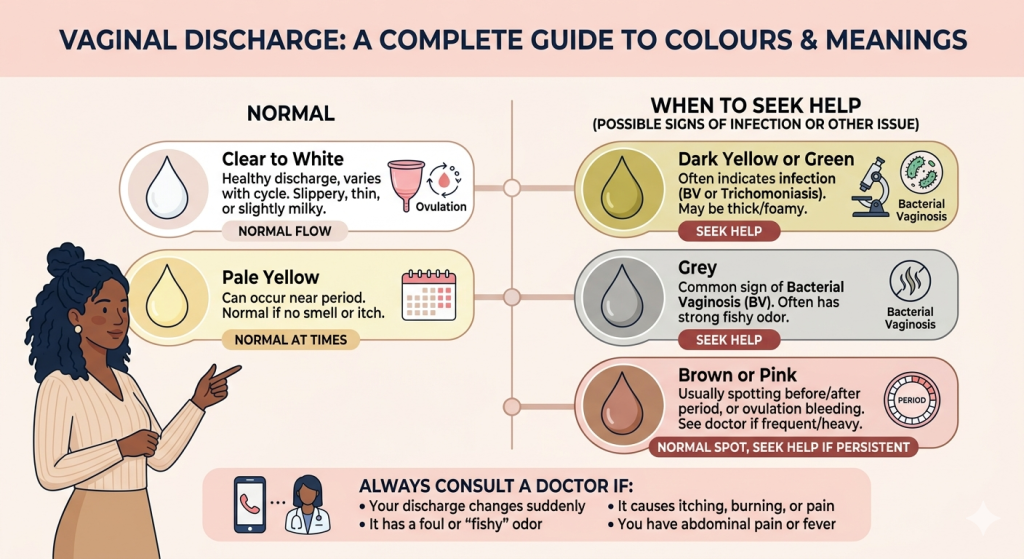
Vaginal discharge colours: what is normal and what is not. If you’ve ever looked at your underwear or toilet paper and wondered whether the colour of your discharge means something is wrong, you are not alone. Vaginal discharge colour is a question many women search for when they notice discharge that looks different from usual and want a clear, calm answer. For most women, discharge changes slightly throughout the month. Clear, white, or off-white discharge is often normal. Colours like grey, green, bright yellow, or blood-stained discharge are more likely to need attention, especially if there is a strong smell, itching, burning, pain, or bleeding outside your period. What is it? Vaginal discharge is fluid made by the vagina and cervix. It helps keep the vagina clean, moist, and protected. ACOG says normal discharge is usually clear to white and has no noticeable odour. Cleveland Clinic also notes that healthy discharge can be clear, milky white, or off-white, and its texture can vary throughout the menstrual cycle. What normal discharge can look like Normal discharge may be: clear white or off-white watery slightly sticky creamy stretchy and slippery around ovulation These changes often occur because hormones fluctuate throughout the month. Cervical mucus naturally changes around ovulation, when it can become more slippery or egg-white-like. Why colour gets so much attention When people search for vaginal discharge colours, they are usually trying to work out whether a colour change is harmless or a warning sign. Colour matters, but it is not the only clue. Smell, texture, itching, burning, pelvic pain, and whether the change is new for you all matter too. Why does it happen? The short answer is that discharge changes because your body changes. Hormones, ovulation, your period, pregnancy, infections, irritation, and menopause can all affect how discharge looks. Mayo Clinic says unusual discharge can happen with yeast infection, bacterial vaginosis, sexually transmitted infections, pregnancy, menopause-related changes, and some hygiene products. Brown Discharge Before Your Period: What It Means Common colour meanings i. Clear or white This is usually normal. ACOG and NHS both note that healthy discharge is often clear or white. ii. Thick white This can still be normal at some points in the cycle. But if it looks clumpy, like cottage cheese, and causes itching or soreness, thrush becomes more likely. iii. Yellow A pale yellow discharge may sometimes be harmless, especially if it has no odour or causes no irritation. But dark yellow discharge, or yellow discharge with pain, smell, or itching, may need checking. ACOG notes that yellow discharge that differs from your normal can occur with some STIs. iv. Green Green discharge is not usually considered normal and may indicate an infection, especially if it is frothy or accompanied by irritation. NHS lists green or yellow frothy discharge as a possible sign of trichomoniasis. v. Grey Grey discharge, especially if thin and fishy-smelling, often raises concern for bacterial vaginosis. The NHS describes bacterial vaginosis as commonly causing greyish-white, thin discharge with a strong fishy smell. vi. Brown or blood-tinged Brown discharge can happen when old blood mixes with vaginal fluid. It may appear around the start or end of a period. But bleeding between periods or after menopause should not be ignored. Signs or symptoms When thinking about vaginal discharge colours, it helps to look beyond colour alone. Signs that are often less worrying These usually fit with normal discharge: clear, white, or off-white colour mild change in amount across the month no strong odour no itching, burning, or pain stretchy mucus around ovulation Signs that may point to a problem These deserve more attention: fishy smell thick, clumpy, white discharge with itching green, grey, or unusually yellow discharge soreness, swelling, or burning pain when peeing or during sex pelvic pain spotting outside your period The NHS and Mayo Clinic both advise getting checked if discharge changes in colour, smell, or texture and is accompanied by irritation, bleeding, or pain. Spotting Before Your Period: Causes, Timing & When to Worry What is normal, and when to pay attention This is where vaginal discharge colour becomes most useful. Not every change means a problem. Your usual pattern matters. Usually normal Clear, milky, or off-white discharge This is the range most often considered healthy. Cycle-related changes You may notice more discharge before ovulation or in the weeks before your period. ACOG notes that discharge can become thicker and heavier in the weeks leading up to menstruation. Mild brown discharge around a period This can be old blood rather than a fresh problem. Pay attention when The discharge is new or clearly different. A big change from your usual pattern matters more than a small variation. There is a strong smell. A fishy smell often needs assessment, especially with grey discharge. There is itching, burning, or soreness. These symptoms suggest irritation, thrush, vaginitis, or infection. There is bleeding outside your period. This should not be brushed off, especially after menopause. When to speak to a doctor If you are searching vaginal discharge colours because something feels off, trust that instinct. Speak to a doctor, sexual health clinic, or nurse if you have: green, grey, or strong yellow discharge discharge with a strong, unpleasant smell itching, burning, swelling, or pain bleeding between periods or after sex pelvic pain Symptoms that keep coming back a new discharge change during pregnancy any bleeding or brown discharge after menopause Mayo Clinic recommends medical review for greenish, yellowish, thick, cheesy, or strongly smelling discharge, and for itching, burning, irritation, or spotting outside your period. A practical reminder Try not to self-diagnose based solely on colour. Different infections and causes can overlap, and the right treatment depends on the actual cause. NHS specifically advises against self-diagnosing unusual discharge. Key takeaway If you have been looking for vaginal discharge colours, the main thing to remember is this: clear, white, and off-white discharge is often normal, while grey, green, strongly yellow, foul-smelling, itchy, painful, or blood-stained discharge outside your period deserves more attention.

Vaginal Discharge Colours: What’s Normal? Read More »

Brown Discharge Before Your Period: What It Means

Brown discharge before your period: what it means If you’ve noticed brown discharge before your period, it’s completely understandable to wonder whether it is normal, whether something is wrong, or whether you should get checked. For many women, brown discharge before their period turns out to be old blood mixing with normal vaginal fluid, especially around the start or end of a cycle. But sometimes it can point to irritation, hormonal changes, pregnancy-related spotting, or an infection. Quick answer: In many cases, brown discharge before your period is just a small amount of old blood slowly leaving the body. It is often harmless, especially if it happens for a day or two and your period arrives as expected. If it comes with pain, bad smell, itching, unusual bleeding, or happens after menopause, it is worth speaking to a doctor. What is it? Brown discharge before your period is vaginal discharge that looks light brown, dark brown, rust-colored, or almost black. The colour usually comes from older blood. Fresh blood is red, but when blood takes longer to leave the uterus or vagina, it oxidises and turns brown. Cleveland Clinic notes that brown discharge often occurs when blood mixes with vaginal fluid, which is why it may appear as streaks, spots, or light staining in your underwear. Why the colour matters Brown discharge is different from the usual clear or white discharge many women have during the month. Normal discharge is typically clear to white and should not have a strong odour. A colour change is not always a problem, but it is something to notice in context with the rest of your symptoms. What it can look like You might notice: light brown spotting on toilet paper dark brown streaks in underwear brown mucus-like discharge a small amount of brown discharge for 1 to 2 days before bleeding starts Spotting Before Your Period: Causes, Timing & When to Worry Why does it happen? There are several reasons for brown discharge before your period, and many of them are not serious. i. Old blood leaving the body This is the most common reason. Sometimes the uterus sheds a very small amount of lining before full menstrual flow starts. Because that blood leaves slowly, it looks brown rather than bright red. ii. Hormonal changes Hormone shifts can cause light spotting before a period. This may happen during times when cycles are changing, such as: puberty perimenopause after stress after major weight changes with some hormonal contraception Mayo Clinic notes that hormone imbalance and anovulation can lead to unexpected bleeding between periods. Breakthrough bleeding can also happen with birth control pills. iii. Early pregnancy spotting Sometimes what seems like brown discharge before your period is actually very light early pregnancy spotting. This can happen around the time a period is expected. Early pregnancy bleeding is common and does not always signal a major problem, but pregnancy-related bleeding should still be taken seriously, especially if there is pain. iv. Infection or irritation If the discharge also smells unpleasant, causes itching, burning, pelvic pain, or comes with bleeding after sex, it may be linked to an infection or another cause of abnormal bleeding rather than a simple pre-period change. The NHS advises getting checked if discharge changes in smell, colour, or texture, especially if accompanied by pain or bleeding. v. Other causes Less commonly, brown discharge before your period can be linked to: Cervical or uterine causes polyps fibroids changes in the lining of the uterus cervix irritation Cycle irregularity missed ovulation irregular periods recent change in contraception Signs or symptoms Brown discharge before your period is more likely to be harmless when: it lasts only a short time it is light spotting, not heavy bleeding there is no strong smell there is no itching or burning your period starts normally soon after Symptoms that can happen alongside it You may also notice: mild cramping a heavier flow starting later that day or the next day sticky or mucus-like discharge light spotting only when wiping Symptoms that deserve more attention Pay closer attention if you have: pelvic pain that is strong or worsening bad-smelling discharge fever itching, soreness, or burning bleeding after sex very irregular bleeding a missed period with spotting and possible pregnancy Bleeding Between Periods: Common Causes and When to Get Checked What is normal, and when to pay attention A small amount of brown discharge before your period can be normal. Many women see this once in a while, and it may mean the period is about to start. Usually considered normal Brown discharge is often normal when: It happens briefly A day or two before your period can be a normal pattern. It is light A few spots or a small streak is usually less concerning than heavier bleeding. It fits your usual cycle. If this happens sometimes and your cycle is otherwise predictable, it may be how your body starts menstruation. Pay attention when it is new, persistent, or unusual. It is a good idea to keep track if: it keeps happening over several cycles when it never used to it lasts many days it becomes heavier it happens at random times in the month you are pregnant or might be pregnant you have gone through menopause ACOG says spotting between periods counts as abnormal uterine bleeding and should be assessed in the right clinical context. NHS guidance also says postmenopausal bleeding, even a small amount of pink or brown discharge, should always be checked. When to speak to a doctor Speak to a doctor or sexual health clinician if brown discharge before your period: Needs routine medical advice keeps happening and is new for you comes with pelvic pain comes with a fishy or unpleasant smell causes itching, burning, or irritation happens after sex is linked with missed periods or possible pregnancy starts after beginning or changing contraception and does not settle Needs urgent medical advice Get urgent help if you have: severe one-sided pelvic pain heavy bleeding

Brown Discharge Before Your Period: What It Means Read More »

Spotting Before Your Period: Causes, Timing & When to Worry

Spotting before your period: what it means, why it happens, and when to worry If you’ve noticed spotting before your period, it can be hard not to wonder what your body is trying to tell you. Is it just part of your cycle? Could it mean pregnancy? Or is it a sign that something else is going on? The good news is that spotting before your period is often linked to common, non-serious causes like hormonal shifts, ovulation, or birth control. But sometimes it needs a closer look, especially if it is new, frequent, painful, heavy, or happening after sex. What is it? Spotting before your period means light bleeding or blood-stained discharge that happens before your usual menstrual flow starts. It is usually much lighter than a period. You might only notice a few drops on your underwear, a little pink, red, or brown discharge, or blood when you wipe. How spotting is different from a period A full period usually follows a more recognisable pattern. A normal menstrual cycle often comes every 21 to 35 days, and bleeding usually lasts 3 to 7 days. Spotting is more likely to be: light enough for a liner rather than a pad or tampon pink, light red, brown, or rust-coloured brief, often lasting hours to 1 to 2 days off-pattern for your usual cycle Why Is My Period Late but I’m Not Pregnant? Common Causes, Hormone Changes, and When to Worry Why does it happen? There is no single reason for spotting before your period. Timing matters a lot. i. Hormonal changes Small hormone shifts can cause the uterine lining to shed a little early. This can happen naturally in some cycles, especially around ovulation or in the days leading up to a period. Ovulation spotting tends to happen around the middle of the cycle, often about halfway between one period and the next, and is usually very light and short-lived. ii. Birth control Hormonal contraception is one of the most common causes of bleeding between periods. This includes the pill and other hormone-based methods. Breakthrough bleeding is often harmless, but it is still worth mentioning to a clinician if it continues or changes. iii. Early pregnancy Sometimes spotting before your period is actually implantation bleeding. This can happen when a fertilised egg implants into the lining of the uterus. It is usually very light, often pink or brown, and tends to happen about 10 to 14 days after ovulation, which can be close to when a period is due. iv. Infections or irritation Sexually transmitted infections can cause bleeding between periods. Bleeding after sex can also happen with cervical changes, vaginal dryness, or irritation. v. Polyps, fibroids, PCOS, or endometriosis Small growths, such as polyps or fibroids, can cause spotting. Conditions like PCOS can disrupt the cycle, and endometriosis can cause pain plus bleeding between periods. vi. Perimenopause As hormones become less predictable in the years leading up to menopause, cycles can become less regular, and spotting may show up more often. Any bleeding after menopause, though, should always be checked. Signs or symptoms Spotting before your period can look slightly different from one woman to another, but there are a few common patterns. What it may look like a few drops of blood on toilet paper light pink, red, or brown discharge very light staining on the underwear bleeding that lasts less than a day or up to 2 days What may come with it? Mild symptoms that can happen with normal spotting light cramping breast tenderness bloating changes in discharge Symptoms that deserve more attention pelvic pain that feels stronger than usual bleeding after sex foul-smelling discharge fever missed period plus pain bleeding that gets heavier or keeps returning Bleeding between periods: common causes and when to get checked What is normal, and when to pay attention A small amount of spotting before your period can be normal once in a while, especially if: it is very light it stops within a day or two it happens around ovulation it occurs soon after starting or changing hormonal birth control you have no severe pain or other worrying symptoms Pay closer attention if it is: happening every cycle when it never used to getting heavier lasting longer than a couple of days happening after sex linked with severe pain, dizziness, or unusual discharge happening after menopause A practical next step If spotting before your period is new or confusing, track: when it happens what colour it is how long it last whether you have pain, sex-related bleeding, or other symptoms whether pregnancy is possible That record can make a doctor’s appointment much more useful. Cleveland Clinic also recommends tracking where the spotting falls in your cycle to help work out whether it matches ovulation or something else. When to speak to a doctor It is sensible to speak to a doctor or a sexual health clinic if you are bleeding between periods or after sex. NHS guidance says that unusual bleeding is often not serious, but it should still be checked. Book an appointment soon if: spotting before your period keeps happening your periods have changed noticeably you have bleeding after sex you think you might be pregnant you have symptoms of infection you have pelvic pain or worsening cramps Get urgent help if: you have missed a period, have unusual bleeding, and have tummy or pelvic pain the bleeding becomes heavy you feel faint, weak, or unwell A missed period with bleeding and pain can be a sign of ectopic pregnancy, which needs urgent assessment. Key takeaway Spotting before your period is common, and in many cases it comes down to hormones, ovulation, contraception, or early pregnancy. But it is worth paying attention to the pattern. If it is new, persistent, painful, heavy, or tied to other symptoms, getting checked is the safest next step. You do not need to panic, but you do not need to ignore it either. Frequently Asked Questions Is spotting before your

Spotting Before Your Period: Causes, Timing & When to Worry Read More »

Bleeding After 40: When Irregular Bleeding Needs a Medical Check

Bleeding after 40: When irregular bleeding needs a medical check If you’re dealing with bleeding after 40, it can be hard to know whether this is just a normal part of perimenopause or something that needs medical attention. A lot of women notice their periods becoming heavier, closer together, farther apart, or more unpredictable in their 40s. That can be common, but not every change should be brushed aside. Quick answer Bleeding after 40 is often linked to perimenopause, when hormone levels start shifting and periods become less predictable. But bleeding that is very heavy, happens after sex, appears between periods regularly, or shows up after menopause should be checked by a doctor. The key is not to panic, but not to ignore it either. If bleeding feels new, unusual for you, or hard to explain, it is worth getting medical advice. What is it? Bleeding after 40 usually refers to changes in vaginal bleeding or periods that happen in your 40s and beyond. This might include: Changes you may notice periods coming closer together skipped periods spotting between periods heavier bleeding than usual bleeding that lasts longer than your usual pattern bleeding after sex bleeding after menopause What doctors call it When bleeding falls outside your usual pattern, it may be described as abnormal uterine bleeding. That does not automatically mean something serious is wrong. It simply means the timing, amount, or pattern of bleeding is different enough to deserve attention. Why does it happen? For many women, bleeding after 40 happens because the body is moving through perimenopause. During this phase, ovulation becomes less regular. That can affect how the womb lining builds up and sheds, which is why periods may become more unpredictable. Missing Periods in Perimenopause: Why It Happens and When to Pay Attention Common reasons it can happen i. Hormone changes in perimenopause This is one of the most common reasons. You may skip a month, then have a heavier or longer bleed the next time. ii. Fibroids or polyps These growths are often non-cancerous, but they can cause heavier bleeding, longer periods, or bleeding between periods. iii. Adenomyosis or other womb changes Changes in the uterus can make periods heavier or more painful. iv. Medicines and contraception Hormone replacement therapy, some contraceptives, and other medicines can affect bleeding patterns. v. Vaginal dryness or thinning after menopause After menopause, the tissues of the vagina and womb can become thinner and more fragile, which can lead to bleeding. vi. Less common but important causes Sometimes irregular bleeding can be linked to a more serious problem, including endometrial changes or cancer. That is why bleeding after menopause, or bleeding that clearly feels wrong for you, should never be ignored. Signs or symptoms Not all bleeding after 40 looks the same. Some changes are subtle, while others are hard to miss. Signs to notice your period is much heavier than usual you soak through pads or tampons very quickly your periods start lasting much longer you bleed between periods you bleed after sex your cycle becomes very unpredictable you feel tired, weak, or short of breath, which can happen if heavy bleeding leads to anaemia you have bleeding more than 12 months after your periods stopped Symptoms that deserve extra attention i. Heavy bleeding that affects daily life If you are changing period products every 1 to 2 hours, avoiding normal activities, or worrying about flooding or leaking, that is worth discussing with a doctor. ii. Bleeding after menopause Any vaginal bleeding after menopause should be assessed. NHS guidance says you should see a GP if this happens, and referral for specialist assessment is standard. What is normal and when to pay attention This is usually the part women want answered most clearly: what counts as normal, and what should not be ignored? What can be common in your 40s During perimenopause, it can be common for periods to: become irregular be lighter or heavier than before come earlier or later than expected occasionally be skipped altogether That said, “common” does not always mean “nothing to check.” A change can be hormone-related and still deserve medical review if it is severe, persistent, or unusual for you. Pay attention if: i. The bleeding is much heavier than your normal period. Especially if it disrupts daily life or causes anaemia symptoms. ii. You are bleeding between periods often. A single random episode may not be serious, but repeated spotting or bleeding between periods should be assessed. iii. You bleed after sex. This can have simple explanations, but it still needs checking. iv. You have bleeding after menopause. This is one of the clearest signs to get medical advice promptly. Postmenopausal bleeding is not considered normal. v. The pattern is new and keeps happening. If bleeding after 40 becomes a pattern rather than a one-off, it is sensible to book an appointment. Perimenopause symptoms: How to tell if the changes you’re noticing are normal When to speak to a doctor You should speak to a doctor about bleeding after 40 if it is persistent, heavy, unpredictable, or simply not typical for you. Make an appointment soon if: your periods have changed significantly you are bleeding between periods you are bleeding after sex you have very heavy periods bleeding is making you feel faint, drained, or unwell you think you may be becoming anaemic you are worried, even if you are not sure it is serious Seek urgent help if: you are soaking through pads or tampons rapidly for hours you feel dizzy, faint, breathless, or very weak you have severe pain with heavy bleeding you may be pregnant and are bleeding One rule that matters most Any bleeding after menopause needs medical review If you have gone 12 months without a period and then bleed, it should be checked. NICE guidance includes postmenopausal bleeding in urgent cancer referral pathways, not because cancer is the most likely cause, but because it is important to rule it out. Key takeaway Bleeding after

Bleeding After 40: When Irregular Bleeding Needs a Medical Check Read More »