
Hormone replacement therapy can ease hot flushes, sleep disruption, and mood changes, but many women still ask the same practical question: Do you still need birth control during menopause transition if you’re on HRT? It is a very real concern, especially when periods become irregular, and your body starts sending mixed signals. You may feel less fertile, but that does not always mean you are unable to get pregnant.
Quick answer:
Yes, in most cases, you still need birth control during menopause transition, even if you are taking HRT. HRT helps with symptoms, but it is not a contraceptive. You usually need contraception until menopause is confirmed, or until age 55 in many cases, depending on your situation and the method you use.
What is Hormone Replacement Therapy?
i. HRT and contraception are not the same thing
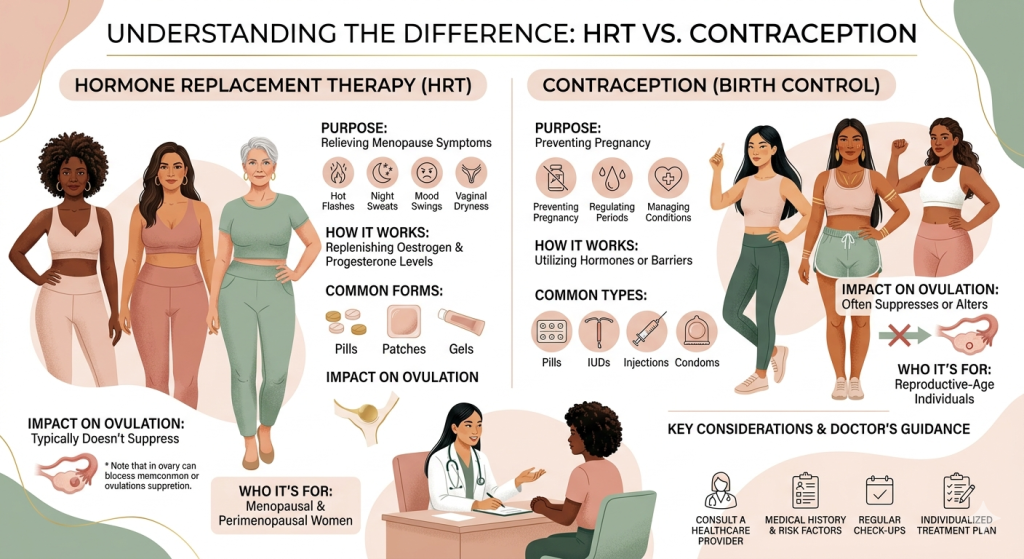
Hormone Replacement Therapy (HRT) is a treatment for menopause symptoms. It replaces some of the hormones that naturally fall during perimenopause and menopause, especially oestrogen, and sometimes progesterone. It can help with hot flushes, night sweats, vaginal dryness, sleep problems, and low mood.
Contraception, on the other hand, is there to prevent pregnancy.
That is the key point that many women are not clearly told: HRT does not count as birth control during menopause transition. Even if it helps your symptoms and changes your bleeding pattern, it does not reliably stop ovulation.
ii. What does menopause transition mean
Menopause transition, often called perimenopause, is the time when hormone levels begin to fluctuate and periods become less predictable. Fertility drops, but pregnancy can still happen until menopause is reached. Menopause is usually confirmed after 12 months without a period if you are not using hormonal contraception that affects bleeding.
Perimenopause symptoms: How to tell if your changing periods are normal
Why does it happen?
i. Ovulation can still happen, even with irregular periods
During perimenopause, ovulation becomes less regular, not necessarily absent. That means you may skip periods for weeks or months, then ovulate unexpectedly. This is why birth control during menopause transition can still matter, even when your cycles seem to be winding down.
ii. HRT treats symptoms, but does not reliably prevent pregnancy
Some women assume that because HRT contains hormones, it must also prevent pregnancy. Understandable, but not correct. Standard HRT doses are not designed or licensed to work as contraception. If pregnancy is possible for you and you do not want to conceive, you need a separate contraceptive plan.
Common situations where this question comes up
- Your periods are irregular, so you are unsure whether you are still fertile
- You have started HRT and assumed it would cover both symptoms and contraception
- You have a coil, mini-pill, or implant and wonder whether you can use it with HRT
- You are over 50 and trying to work out when contraception can safely stop
Signs or symptoms
i. Signs you may still need contraception
If any of these apply, birth control during menopause transition is still worth discussing:
- You are still getting periods, even if they are far apart
- You are under 55 and still sexually active with a male partner
- You are taking HRT
- You are using a hormonal contraceptive that makes bleeding stop, so your periods are no longer a reliable clue
- You are not yet sure whether menopause has been reached
ii. Symptoms that can confuse the picture
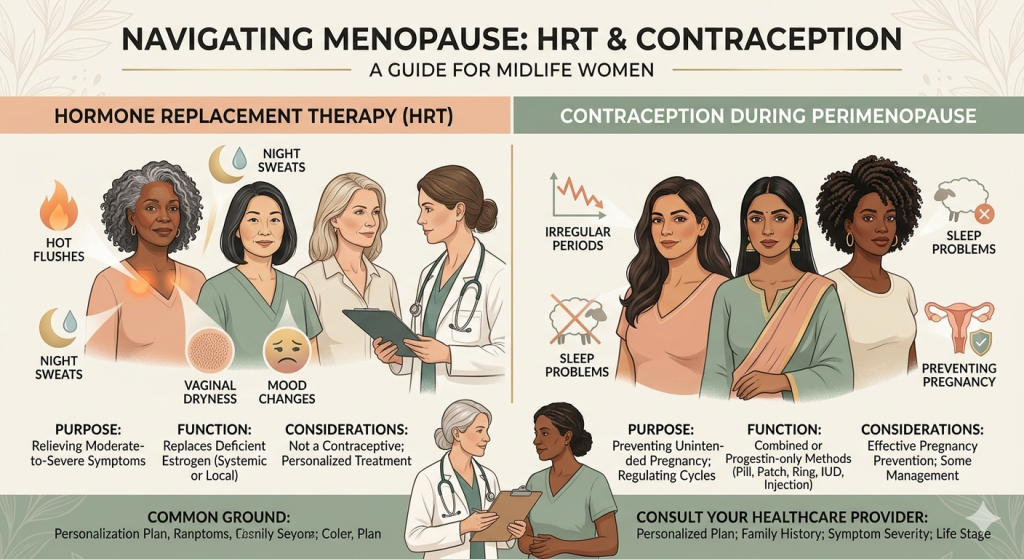
Perimenopause can bring:
- Irregular periods
- Hot flushes
- Night sweats
- Mood changes
- Sleep problems
- Vaginal dryness
These symptoms can happen while pregnancy is still technically possible. Symptoms alone cannot tell you whether you still need birth control during menopause transition.
Why Is My Period Late but I’m Not Pregnant? Common Causes, Hormone Changes, and When to Worry
What is normal, and when to pay attention
i. What is usually normal
For many women, it is normal to need both symptom relief and contraception at the same time. This overlap can last for a few years. It is also normal for bleeding patterns to change once HRT or hormonal contraception is started.
ii. General timing rules, women are often given
In general, contraception can often be stopped:
- 1 year after the last natural period if you are over 50
- 2 years after the last natural period if you are under 50
- At age 55, when a natural pregnancy becomes exceptionally rare for most women
iii. Important reminder
These timing rules can get trickier if you are using hormonal contraception or HRT, because they may affect bleeding and make menopause harder to judge. Hormone blood tests, such as FSH, are also not reliable for women using combined hormonal contraception or HRT.
Practical options that may be discussed with a clinician
Depending on your age and medical history, a doctor or sexual health clinician may discuss:
- A progestogen-only pill alongside HRT
- A hormonal coil that may help with contraception and, in some cases, can be used as the progesterone part of HRT if it is the right type and changed on schedule.
- A copper coil
- A contraceptive implant
- Switching off the combined pill around age 50 and moving to another method if appropriate

When to speak to a doctor
i. Make an appointment if:
- You are starting HRT and are unsure what to do about contraception.
- Your periods have stopped, but you are using hormones and cannot tell whether menopause has happened.
- You want to know when it is safe to stop birth control during menopause transition.
- You have new, heavy, prolonged, or unpredictable bleeding.
- You think you might be pregnant.
- You have migraines with aura, a history of blood clots, smoking over age 35, high blood pressure, breast cancer history, or other conditions that may affect which options are safe for you.
A medically responsible next step is simple: do not stop contraception based on age, symptoms, or missed periods alone if you are using HRT or hormonal contraception. Get personalised advice.
What Does a Hot Flush Feel Like? Signs, Causes and Relief
Key takeaway
If you remember one thing, let it be this: HRT is not birth control during menopause transition. You may still ovulate during perimenopause, even with irregular periods and even while using HRT. For many women, the safest path is to use contraception until menopause is clearly confirmed or until age 55, depending on the method and their health history.
FAQs
Can I get pregnant while taking HRT?
Yes. HRT does not reliably prevent ovulation or pregnancy, so you may still need birth control during menopause transition.
At what age can I stop using contraception in perimenopause?
Many women can stop at 55. Some can stop earlier based on age and time since their last natural period, but this depends on whether hormones are affecting bleeding patterns.
Can I use the mini-pill with HRT?
Often, yes. This is a common option, but the best choice depends on your personal medical history.
Can I use a Mirena coil with HRT?
In some cases, yes. A 52 mg levonorgestrel IUD may provide contraception and may also be used as the progestogen part of HRT, but it must be the correct device and replaced according to HRT guidance, which is different from contraception-only timing.
Do I need a hormone test to know when to stop contraception?
Not always, and hormone tests are not reliable for everyone. If you are on HRT or combined hormonal contraception, FSH testing does not give accurate guidance about when to stop contraception.
Medical disclaimer
This article is for general education and does not replace medical advice. Menopause, HRT, and contraception decisions should be tailored to your age, bleeding pattern, symptoms, and health history. If you are unsure whether you still need birth control during menopause transition, speak to your GP, menopause specialist, or sexual health clinic.