


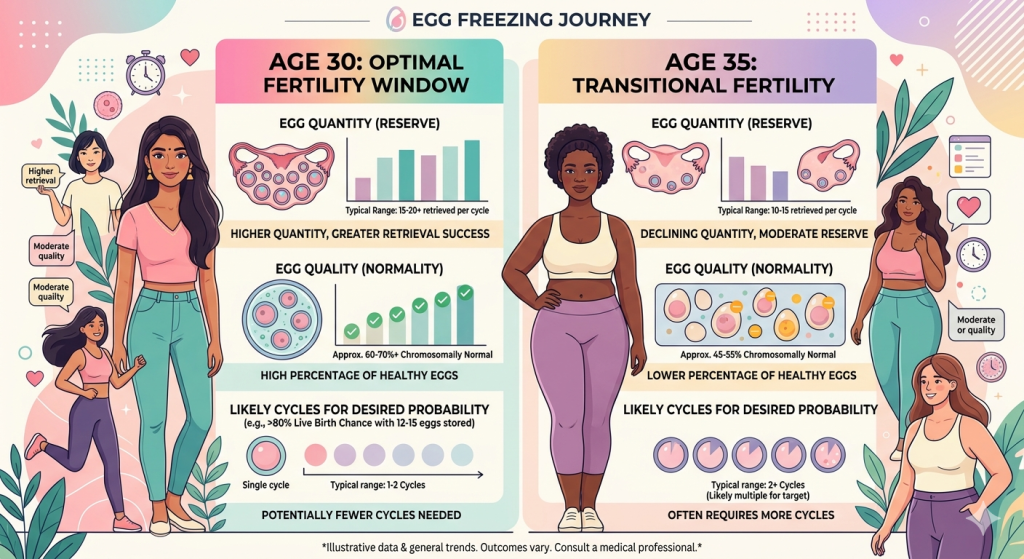
If you are choosing strictly between 30 and 35, freezing eggs at 30 usually offers better odds. But 35 is not automatically too late; success depends on age, egg number, ovarian response, and clinic outcomes.
Why Five Years Can Matter for Egg Freezing
Thirty and 35 can feel surprisingly close when you are living your life.
Five years can pass through a promotion, a relationship that did not work out, caring responsibilities, financial decisions, or simply not feeling ready to have a child yet.
Biologically, though, those years can matter.
Women are born with a finite number of eggs, and both egg number and reproductive potential decline with age. Additionally, lifestyle factors like smoking, BMI, and stress can accelerate this decline and affect egg quality. ACOG notes that fertility begins declining around age 30 and that the decline becomes faster in the mid-30s. (ACOG)
Egg freezing—also called oocyte cryopreservation—allows eggs to be collected and stored at the age you are now. That matters because outcomes are generally better when eggs are frozen at younger ages. ASRM concludes that available evidence, while still limited, shows better ongoing pregnancy and live-birth outcomes when planned egg freezing is performed younger rather than later. (ASRM)
Read ACOG’s guide to fertility and age
If pregnancy itself is already on your mind, you may also want to read FemPhases’ Trying to Conceive After 35: What Changes and What Doesn’t.
What Choosing Between 30 and 35 Can Look Like in Real Life
The decision rarely arrives as a neat medical question.
At 30, you might wonder whether freezing eggs is premature. Your unique life plans and health can influence whether it’s the right choice for you, helping you feel more confident in your personal decision.
At 35, the question can feel more urgent. You may still be single, recently out of a relationship, building a career, unsure about motherhood, or simply want more time.
None of these situations means you have made a mistake.
What changes is the biological starting point. Younger ovaries generally produce more eggs during stimulation, and younger eggs have greater reproductive potential on average. That does not mean every 30-year-old will respond better than every 35-year-old. Individual ovarian response varies considerably.
HFEA data shows that the average age of patients freezing eggs in the UK was 35 in 2023, so considering the procedure at 35 is hardly unusual. HFEA also stresses that egg freezing can increase reproductive choice but should not be viewed as a guarantee of having a baby later. (HFEA)
Explore the HFEA egg-freezing factsheet
What Egg Freezing Can and Cannot Preserve
Egg freezing preserves eggs, not time itself.
The process usually involves hormone injections to stimulate the ovaries, monitoring with scans and sometimes blood tests, egg collection under sedation or anaesthesia, and freezing the mature eggs for future use. HFEA says a typical freezing cycle takes roughly two to three weeks. (HFEA)
What it may give you is another reproductive option later, empowering you to make choices aligned with your future plans.
What it cannot do is:
- guarantee pregnancy or a live birth
- guarantee that every frozen egg will survive thawing
- guarantee fertilisation or healthy embryo development
- stop the rest of your body from ageing
- remove age-related pregnancy risks if you become pregnant later
- promise that one egg-freezing cycle will be enough
That last point matters. There is no universal “magic number” of eggs that guarantees one baby. ASRM specifically says current evidence is insufficient to prescribe an absolute number of frozen eggs that will reliably produce a live birth for every age group. (ASRM)
 What About AMH Testing?
This is where many women encounter AMH, or anti-Müllerian hormone.
AMH is one marker of ovarian reserve, which broadly refers to the remaining quantity of eggs. Together with an antral follicle count on ultrasound, it can help a fertility clinic estimate how your ovaries may respond to stimulation.
What AMH cannot reliably tell you is, “You have X years of fertility left.”
ASRM advises that ovarian-reserve tests are useful for predicting likely egg yield during fertility treatment but are poor independent predictors of natural reproductive potential. Age remains a much stronger predictor. (ASRM)
Read ASRM’s guidance on ovarian reserve testing
For more on understanding your fertile window rather than relying on one test alone, see FemPhases’ Egg White Discharge and Fertility: What It Means Around Ovulation.
How to Make the Decision Without Letting Fear Make It for You
You do not need to decide from a headline telling you that your fertility is “running out”.
A useful consultation should help you understand your own situation.
Consider asking:
- What egg yield might you reasonably expect from one cycle?
- How does your age affect the clinic’s expected outcomes?
- Would your AMH and follicle count change the treatment plan?
- What are the full costs, including medication, storage and future thawing or IVF?
- How often do patients your age return to use their eggs?
- What are the clinic’s success rates for women who froze eggs at your age?
- How would your plan change if you want more than one child?
Ask for age-specific clinic data, not one impressive headline percentage.
HFEA notes that risks and costs vary by clinic and personal health, so understanding these factors can help you feel more prepared and reassured about your options.
Read HFEA guidance on egg freezing, success and risks
It is worth getting support if…
- you are deciding whether to freeze now or wait several years
- you are 35 or older, and future pregnancy matters to you
- your periods are becoming very irregular or have stopped unexpectedly
- you have endometriosis, previous ovarian surgery or another condition that may affect fertility
- you have a family history of premature or early menopause
- chemotherapy, radiotherapy or other treatment may affect your ovaries
- fertility uncertainty is beginning to dominate your decisions or wellbeing
If your menstrual pattern itself has recently changed, FemPhases’ Why Is My Cycle Suddenly Shorter? may also help you understand what deserves further discussion.

Conclusion
If the choice really is 30 versus 35, 30 generally offers the biological advantage.
But that is not the same as saying every woman should freeze her eggs at 30 or that arriving at 35 means you have missed your opportunity.
The best fertility decision has to fit more than an ovary. It has to fit your finances, hopes, relationships, health, tolerance for treatment and the life you are actually living.
Egg freezing is best understood as preserving an option, not purchasing certainty.
A good consultation should leave you feeling better informed about that option not frightened into taking it.
Frequently Asked Questions Women Often Ask
Is 35 too late to freeze my eggs?
No. Many women freeze eggs at 35 and later. Outcomes generally become less favourable with age, however, so it is sensible to discuss likely egg yield and age-specific success rates with a fertility specialist.
Is 30 too young?
Not necessarily. Biologically, younger freezing is usually advantageous. Whether it makes sense personally depends on how likely you are to need the eggs, cost, fertility plans and your circumstances.
Does regular ovulation mean my egg quality is still good?
Regular periods can suggest ongoing ovulation, but they cannot measure egg quality. Age remains an important fertility factor even in women with predictable cycles.
Does a low AMH mean I cannot become pregnant naturally?
No. AMH is more useful for estimating ovarian response and possible egg yield during treatment than predicting whether an individual woman can conceive naturally. (ASRM)
Does egg freezing guarantee a future baby?
No. Some eggs will not survive thawing, fertilise or develop into embryos, and not every embryo leads to pregnancy. Egg freezing expands future options but cannot guarantee an outcome. (ASRM)
Key Takeaways
- If everything else is equal, freezing at 30 generally offers better biological prospects than freezing at 35.
- Being 35 does not mean egg freezing is “too late”.
- Age affects both egg quantity and reproductive potential.
- AMH may help predict treatment response but cannot tell you your fertility expiry date.
- There is no guaranteed number of eggs that produces one baby.
- Ask clinics for realistic, age-specific outcomes and total costs.
- Egg freezing preserves possibility not certainty.
Medical Disclaimer
This article is for educational purposes only and does not replace personalised medical advice, diagnosis or treatment. If you are worried about your fertility, menstrual cycle or reproductive health, please speak with your doctor, nurse practitioner, gynaecologist, fertility specialist, reproductive endocrinologist, or another qualified healthcare professional.