


You may be standing in the kitchen, staring at your phone, trying to remember why you picked it up. Or sitting in the car after work, feeling strangely tearful, even though nothing dramatic has happened. Midlife can arrive quietly like this. One day you are coping, giving, planning, working, caring — and the next, you wonder where you went.
If you have been feeling lost, flat, restless, emotional, or unlike yourself, you are not alone. This article will help you understand why midlife can feel so unsettling, how hormones, sleep, stress, identity, and health can overlap, and what practical steps may help you feel steadier again.
Why Midlife Can Make You Feel Lost
i. Midlife Is Not Just an Age. It Is a Transition.
Midlife is often spoken of as a crisis, but for many women, it is more like a slow internal rearrangement. Your body may be changing. Your relationships may be shifting. Your children may need you differently, or your parents may need you more. Your career may feel demanding, uncertain, or less fulfilling than it once did.
At the same time, you may be asking deeper questions:
- Who am I now?
- What do I actually want?
- Why do I feel so tired of being strong?
- Why do things that used to feel manageable now feel heavy?
These questions do not mean you are failing. They often mean your mind and body are asking for attention after years of pushing through.
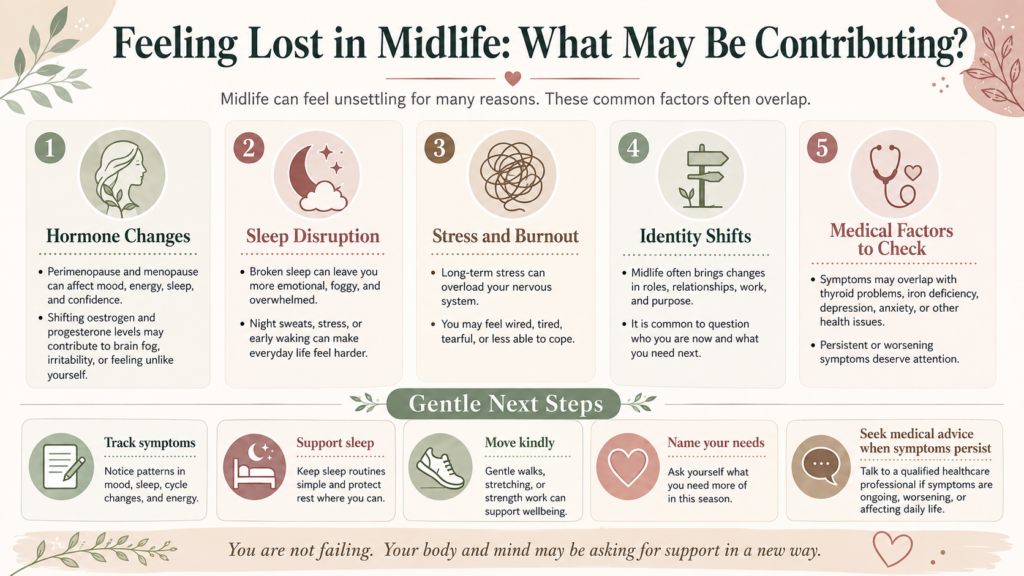
ii. Hormonal Changes Can Affect Mood, Sleep and Confidence
For many women, midlife overlaps with perimenopause, menopause, or postmenopause. Perimenopause is the transition leading up to menopause, when reproductive hormones such as oestrogen and progesterone begin to fluctuate. Menopause is usually confirmed after 12 months without a period.
These hormonal changes can affect more than your periods. They may influence:
- Mood changes
- Anxiety or irritability
- Low motivation
- Poor sleep
- Brain fog
- Hot flushes or night sweats
- Changes in libido
- Vaginal dryness or discomfort
- Joint aches
- Fatigue
This is why some women say, “I don’t feel like myself anymore.” It is not just emotional. It can be biological, psychological, social, and lifestyle-related all at once.
iii. Feeling Lost Is Often Misunderstood
One of the most misunderstood parts of midlife is that emotional changes are often dismissed as “just stress” or “just ageing.” Stress and ageing may be part of the picture, but they are rarely the whole story.
Feeling lost may come from a combination of:
- Hormone fluctuations
- Long-term stress or burnout
- Poor sleep
- Caring responsibilities
- Relationship strain
- Grief, loss, or disappointment
- Work pressure
- Changes in body image
- Unmet needs that have been ignored for years
It is common for women to carry everyone else, emotionally and practically, and then feel confused when their own needs finally surface. Midlife often reveals what has been quietly costing you.
iv. Your Nervous System May Be Overloaded
Your nervous system is the part of your body that helps you respond to stress, danger, rest, and recovery. When life has been demanding for a long time, your body may stay in a more alert state.
This can feel like:
- Waking up tired
- Feeling easily overwhelmed
- Snapping over small things
- Feeling wired but exhausted
- Struggling to relax
- Feeling emotionally numb
- Having less patience than usual
This does not mean you are weak. It may mean your body has had too little recovery for too long.
v. Sleep Changes Can Make Everything Feel Worse
Sleep is one of the first things to change for many women in midlife. You may fall asleep but wake at 3 a.m. with your mind racing. Or you may sleep for hours and still wake feeling unrefreshed.
Poor sleep affects mood, appetite, concentration, pain sensitivity, and emotional resilience. When you are not sleeping well, everyday problems can feel bigger, and your sense of self can feel harder to access.
This is why restoring sleep is not a luxury. It is a foundation.
vi. Sometimes There May Be a Medical Reason Too
Feeling lost, exhausted, low, foggy, or emotionally flat can overlap with several health conditions. These may include:
- Thyroid problems, especially underactive thyroid
- Iron deficiency or anaemia
- Vitamin B12 or vitamin D deficiency
- Depression or anxiety
- Perimenopause or menopause symptoms
- Chronic stress or burnout
- Medication side effects
- Long-term pain or inflammatory conditions
An underactive thyroid, for example, can cause tiredness, low mood, brain fog, sensitivity to cold, weight changes, dry skin, constipation, and heavier or irregular periods. Depression can also show up as loss of interest, hopelessness, low energy, irritability, sleep changes, appetite changes, and difficulty concentrating.
You do not need to diagnose yourself. But you do deserve to be taken seriously.
Midlife Can Also Be a Turning Point
Although this season can feel uncomfortable, it can also become a doorway. Many women begin to notice what no longer fits. The job role. The friendship pattern. The constant overgiving. The silence around their own needs.
Feeling lost may be the beginning of becoming more honest with yourself.
This does not mean making dramatic changes overnight. It means slowly listening again. It means asking, “What would support me now?” instead of only asking, “What does everyone need from me?”
Signs You May Be Feeling Lost in Midlife
You may recognise some of these signs:
- You feel emotionally flat, restless, or disconnected.
- You miss the woman you used to be.
- You feel guilty for wanting more space, rest, or change.
- You are tired of being needed but unsure how to ask for support.
- You feel less confident in your body, work, or relationships.
- You often think, “I should be grateful, so why do I feel this way?”
- You feel anxious, tearful, irritable, or overwhelmed more often than usual.
- You are questioning your purpose, identity, or direction.
These signs are not proof that something is wrong with you. They are signals worth listening to.
Gentle Ways to Feel More Like Yourself Again
1. Start With Your Body, Not Your Willpower
When you feel lost, it is tempting to blame yourself for not being more motivated. Begin with the basics instead:
- Are you sleeping enough?
- Are you eating regular meals?
- Are you drinking enough water?
- Are you moving your body gently?
- Are you carrying too much alone?
Small body-based support can make emotional clarity easier.
2. Track Patterns for Two Weeks
You do not need a complicated journal. Note:
- Sleep quality
- Mood
- Period changes
- Hot flushes or night sweats
- Anxiety or irritability
- Energy levels
- Food, alcohol, caffeine, and stress triggers
Patterns can help you see whether symptoms cluster around your cycle, sleep disruption, stressful days, or possible hormonal changes.
3. Create a “Minimum Care List”
On difficult days, keep support simple:
- Eat something nourishing.
- Step outside for five minutes.
- Do one small movement stretch.
- Send one honest message to someone safe.
- Put one worry on paper instead of holding it all in your head.
This is not about becoming a new person by Monday. It is about giving your current self enough care to breathe.
4. Move in a Way That Feels Kind
Physical activity can support mood, sleep, energy, and long-term health. But you do not have to punish your body to benefit. Try:
- A 10-minute walk
- Gentle strength exercises twice a week
- Stretching while the kettle boils
- Dancing to one song
- Walking during a phone call
Consistency matters more than perfection.
5. Name What You Need Out Loud
Try finishing this sentence:
“In this season of my life, I need more…”
Maybe the answer is rest. Space. Medical support. Friendship. Creativity. Honest conversation. Fun. Time alone. Better boundaries.
Naming your need is not selfish. It is the first step toward caring for yourself with the same seriousness you give everyone else.
When to Seek Help
Please seek professional advice if your low mood, anxiety, exhaustion, sleep problems, brain fog, hot flushes, heavy bleeding, irregular bleeding, pain, or emotional changes are affecting your daily life.
It is especially important to speak with a doctor, nurse practitioner, gynaecologist, endocrinologist, or qualified healthcare professional if you have very heavy periods, bleeding after sex, bleeding after menopause, sudden severe symptoms, chest pain, fainting, thoughts of self-harm, or symptoms that feel unusual for you.
Ask about possible causes such as perimenopause, menopause, thyroid problems, iron deficiency, vitamin deficiencies, depression, anxiety, medication effects, or other health conditions. Getting help does not mean you have failed. It means your body and mind matter.
Summary
Feeling lost in midlife can be deeply unsettling, especially when you are used to coping and carrying on. But this feeling is not a character flaw. It may be a sign that your body, hormones, nervous system, relationships, and inner life are all asking for care in a new way.
You do not have to solve everything at once. Start gently. Notice your patterns. Support your sleep. Move kindly. Ask better questions. And when something feels too heavy to manage alone, reach for professional support. Midlife is not the end of who you are. It may be the beginning of meeting yourself more honestly.
Frequently Asked Questions
1. Is it normal to feel lost in midlife?
Yes, many women feel uncertain, emotional, restless, or disconnected in midlife. This can happen because of hormonal changes, stress, poor sleep, caring responsibilities, relationship changes, work pressure, or a deeper reassessment of identity and purpose.
2. Can perimenopause make me feel unlike myself?
Yes. Perimenopause can affect mood, sleep, concentration, energy, libido, and emotional sensitivity. Some women feel anxious, irritable, tearful, foggy, or less confident, even before their periods stop completely.
3. How do I know if it is hormones or depression?
Hormonal changes and depression can overlap. If symptoms come with cycle changes, hot flushes, night sweats, sleep disruption, or new PMS-like mood swings, hormones may be part of the picture. If low mood, hopelessness, loss of interest, or thoughts of self-harm occur, seek professional support promptly.
4. Can thyroid problems feel like midlife burnout?
Yes. An underactive thyroid can cause tiredness, low mood, brain fog, weight changes, cold sensitivity, constipation, dry skin, hair changes, and menstrual changes. A simple blood test can help check thyroid function.
5. What can I do today if I feel overwhelmed?
Choose one small action: eat a proper meal, drink water, take a short walk, write down what feels heavy, or message someone safe. When you feel overwhelmed, simple support is often more helpful than trying to fix your whole life at once.
6. Should I ask my doctor about menopause treatment?
If symptoms are affecting your sleep, mood, work, relationships, sex life, or daily comfort, it is reasonable to ask about menopause support. Options may include lifestyle support, hormone therapy where appropriate, non-hormonal treatments, CBT-based support, and help for specific symptoms.
7. When is feeling lost a sign I need urgent help?
Seek urgent help if you have thoughts of harming yourself, feel unsafe, have sudden severe symptoms, chest pain, fainting, confusion, severe bleeding, or symptoms that feel frightening or unusual for you.
Medical Disclaimer
This article is for educational purposes only and does not replace personalised medical advice, diagnosis, or treatment. If you are worried about your symptoms, if your symptoms are getting worse, or if something does not feel right in your body, please speak with your doctor, nurse practitioner, gynaecologist, endocrinologist, or another qualified healthcare professional. Seek urgent medical help for severe, sudden, or concerning symptoms.