

There’s a moment many women know intimately.
You finally sit down at the end of the day after work, after family responsibilities, after unread messages, after forgotten water bottles, after mental lists, after everyone else’s needs, and suddenly your body feels louder than your thoughts.
Your heart races for no clear reason.
You’re exhausted but can’t sleep.
You feel emotional, foggy, overstimulated, or strangely disconnected from yourself.
Then comes the quiet question many women carry privately:
“Is something wrong with me?”
As nurses, we hear this question far more often than most people realise.
One of the biggest truths about what nurses wish more women knew about their health is this: many women spend years dismissing symptoms their bodies have been trying to communicate clearly all along. Sometimes it’s because life is busy. Sometimes it’s because they’ve been told their symptoms are “just stress.” And sometimes it’s because women are often expected to keep functioning even when they feel overwhelmed.
Understanding how hormones influence mood, sleep, pain, digestion, and energy can help women feel more informed and less overwhelmed by the interconnected symptoms of their health.
None of this means you are weak, dramatic, or “failing to cope.”
It means you are human.
This article explores what nurses wish more women knew about their health, including the symptoms women commonly ignore, the emotional realities behind hormone changes, and the everyday health patterns that matter more than many people realise.
Why So Many Women Feel Dismissed or Confused About Their Health
Modern women are often expected to function at full capacity while managing fluctuating hormones, emotional labour, caregiving responsibilities, work pressure, interrupted sleep, and chronic stress.
At the same time, many health symptoms in women are normalised or minimised.
Women are commonly told things like:
- “You’re probably just stressed.”
- “It’s normal at your age.”
- “Your blood tests are fine.”
- “You just need more sleep.”
- “You’re overthinking it.”
Sometimes stress is contributing. However, stress itself is also a real physiological health issue.
One important part of what nurses wish more women knew about their health is that symptoms rarely exist in isolation. The body works as an interconnected system.
For example:
- Poor sleep can worsen anxiety and hormone symptoms
- Hormonal shifts can affect memory and mood
- Chronic stress can increase inflammation and fatigue
- Iron deficiency can look like burnout
- Perimenopause can mimic anxiety disorders
- Emotional overload can trigger physical symptoms
Many women do not imagine their symptoms or know what questions to ask. They need clearer explanations, support, and tools to advocate for their health during healthcare conversations.
Your Body Often Speaks Quietly Before It Screams
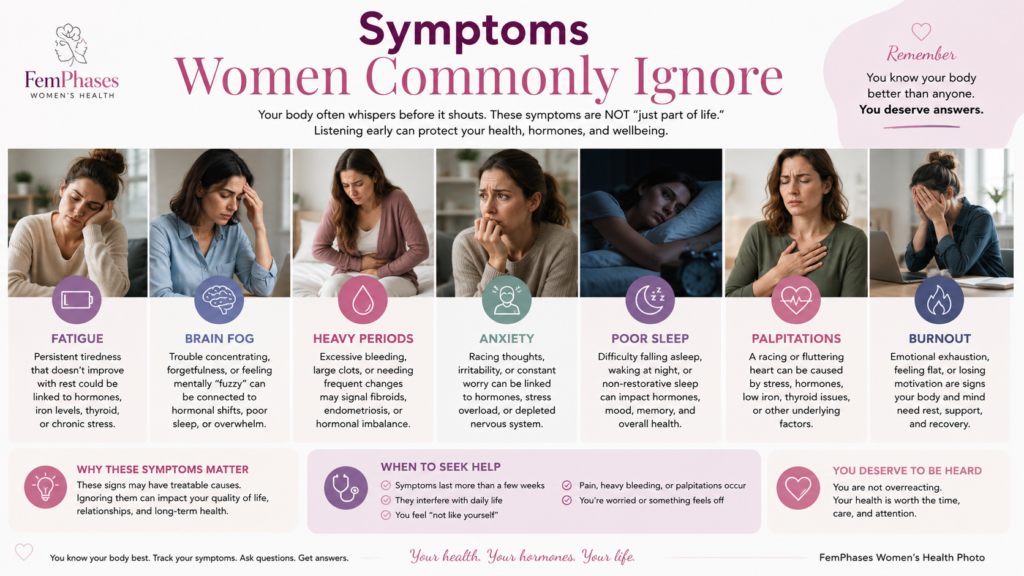
One thing nurses notice repeatedly is that women tend to minimise early warning signs like persistent fatigue, heavy periods, or brain fog, which should prompt a consultation.
Not because they do not care about themselves, but because they are used to pushing through discomfort.
Women often ignore symptoms like:
- Persistent fatigue
- Heavy periods
- Brain fog
- Sleep disruption
- Pelvic pain
- Mood changes
- Anxiety
- Headaches
- Low libido
- Digestive issues
- Burnout
- Joint aches
- Heart palpitations
Many assume these symptoms are simply part of getting older, being busy, parenting, or working under pressure.
Sometimes they are connected to lifestyle strain. However, they can also relate to:
- Iron deficiency
- Thyroid disorders
- Perimenopause
- Endometriosis
- PCOS
- Vitamin deficiencies
- Chronic stress overload
- Anxiety disorders
- Depression
- Sleep disorders
- Autoimmune conditions
One of the most important lessons nurses wish more women knew about their health is that persistent symptoms deserve attention, even if they seem “small.”
You do not need to wait until you completely crash to seek support.
Hormones Affect More Than Periods
Many women are taught about hormones only in relation to fertility or menstruation, but hormones influence sleep, mood, energy, and even skin, which can vary greatly among individuals.
Hormonal changes can affect:
- Sleep
- Mood
- Energy
- Temperature regulation
- Memory
- Skin
- Appetite
- Anxiety levels
- Digestion
- Libido
- Muscle and joint health
This becomes especially noticeable during perimenopause and menopause.
Perimenopause can begin years before periods stop completely. According to the NHS menopause guidance, symptoms may include:
- Anxiety
- Brain fog
- Night sweats
- Sleep problems
- Mood changes
- Irregular periods
- Hot flushes
- Fatigue
- Reduced confidence
Many women are shocked when emotional symptoms appear first.
A woman may think:
- “I’m becoming emotionally unstable.”
- “I can’t cope anymore.”
- “Why do I suddenly feel anxious all the time?”
Sometimes these symptoms are strongly linked to hormonal fluctuation rather than personal weakness.
That does not mean hormones explain everything. Emotional health is complex. However, understanding hormone changes often helps women feel less frightened and more informed.
Exhaustion Is Not Always “Just Being Busy”
Many women live in a near-constant state of nervous system overload.
Their bodies never fully shift out of stress mode.
This can look like:
- Feeling “wired but tired”
- Difficulty relaxing
- Snapping emotionally over small things
- Muscle tension
- Poor sleep despite exhaustion
- Emotional numbness
- Forgetfulness
- Frequent illness
- Feeling detached from joy
One of the clearest realities behind what nurses wish more women knew about their health is that chronic stress changes the body physically.
Long-term stress can affect:
- Cortisol regulation
- Blood pressure
- Immune function
- Hormone balance
- Digestion
- Sleep quality
- Mental health
According to the World Health Organisation, chronic stress can contribute to both physical and psychological symptoms over time.
Many women blame themselves for “not coping better” when their nervous systems are actually overloaded.
Heavy Periods Are Not Something You Should Endure
Many women normalise symptoms that deserve medical evaluation.
Heavy periods are one example.
Signs a period may be abnormally heavy include:
- Bleeding through pads or tampons quickly
- Passing large clots
- Needing to wake frequently at night
- Severe exhaustion during periods
- Symptoms of iron deficiency
- Missing work or avoiding activities because of bleeding
Heavy bleeding can be associated with:
- Fibroids
- Adenomyosis
- Endometriosis
- Hormonal imbalance
- Perimenopause
- Bleeding disorders
The Royal College of Obstetricians and Gynaecologists (RCOG) advises women to seek support if heavy periods affect daily life.
Many women spend years believing they are “supposed” to suffer through symptoms that are actually treatable.
Emotional Symptoms Are Real Physical Health Symptoms
Women often see emotional symptoms as separate from physical health, but understanding that anxiety and mood changes are real Health signals can foster validation and compassion.
The body does not work that way.
Anxiety can affect digestion, sleep, heart rate, pain sensitivity, and hormone regulation. Meanwhile, hormone shifts can influence mood stability and emotional resilience.
One important truth about what nurses wish more women knew about their health is that emotional symptoms deserve proper care and validation.
Feeling emotionally overwhelmed does not automatically mean:
- You are weak
- You are dramatic
- You are failing
- You are “crazy”
Sometimes emotional symptoms are linked to:
- Hormonal changes
- Burnout
- Sleep deprivation
- Chronic stress
- Anxiety disorders
- Depression
- Trauma
- Nutritional deficiencies
- Caregiver overload
Women deserve support that looks at the full picture rather than dismissing emotional symptoms entirely.
Preventive Health Matters More Than Most Women Realise
Many women delay healthcare appointments until symptoms become severe.
This often happens because:
- They are busy caring for others
- They feel guilty prioritising themselves
- Previous healthcare experiences felt dismissive
- They hope symptoms will disappear
However, preventive care matters enormously.
Important health checks may include:
- Cervical screening
- Breast awareness and breast screening
- Blood pressure monitoring
- Cholesterol checks
- Diabetes screening
- Iron and vitamin assessments when indicated
- Thyroid testing when symptoms suggest concerns
According to the CDC Women’s Health Resources, preventive healthcare improves long-term outcomes and helps identify problems earlier.
Looking after your health is not selfish.
It is healthcare maintenance for the body, supporting you throughout your life.
Sleep Problems Are Not “Just Part of Being a Woman”
Sleep disruption is one of the most underestimated women’s health issues.
Poor sleep affects:
- Mood regulation
- Hormones
- Memory
- Appetite
- Blood sugar balance
- Anxiety
- Pain sensitivity
- Cardiovascular health
Yet many women accept exhaustion as normal.
One major lesson in what nurses wish more women knew about their health is that chronic poor sleep deserves attention, especially when paired with symptoms like:
- Snoring
- Severe fatigue
- Night sweats
- Anxiety
- Mood changes
- Frequent waking
- Heart palpitations
Improving sleep sometimes requires lifestyle changes. However, persistent sleep problems may also need medical assessment.
Myth vs Reality
Myth: “If my blood tests are normal, nothing is wrong.”
Reality:
Normal tests do not erase lived symptoms. Some conditions are difficult to detect early, while others fluctuate over time. Good healthcare combines tests, history, symptoms, and clinical judgement.
Myth: “I should be able to cope better.”
Reality:
Many women are functioning under enormous emotional and physical pressure. Struggling does not mean failure.
Myth: “Hormonal symptoms are all in my head.”
Reality:
Hormonal changes can significantly affect mood, sleep, cognition, and emotional regulation.
Myth: “Fatigue is just part of adulthood.”
Reality:
Occasional tiredness is normal. Constant exhaustion is worth exploring.
Practical Takeaways Nurses Often Wish Women Heard Earlier
i. Listen to persistent symptoms.
If something feels repeatedly “off,” it deserves attention.
ii. Track patterns
Symptoms linked to cycles, stress, sleep, or hormones often become clearer when written down.
iii. Rest before complete burnout
You do not need to earn rest through collapse.
iv. Ask questions during appointments.
You deserve explanations you understand.
v. Emotional symptoms matter
Mental health is part of physical health.
vi. Support your nervous system gently.
Small, consistent habits often help more than extreme routines.
Helpful foundations include:
- Regular meals
- Adequate hydration
- Gentle movement
- Sleep routines
- Reduced overstimulation
- Emotional support
- Time outdoors
- Stress management strategies
A More Compassionate Way to Think About Women’s Health
Women are often incredibly hard on themselves.
They apologise for the symptoms.
They minimise exhaustion.
They keep functioning while silently struggling.
Yet one of the deepest truths behind what nurses wish more women knew about their health is that the body is not an inconvenience. Symptoms are not character flaws. Emotional overwhelm is not laziness.
Sometimes the body is asking for:
- medical support,
- hormonal assessment,
- rest,
- nourishment,
- boundaries,
- emotional care,
- or to be listened to seriously.
You deserve healthcare conversations that leave you feeling informed, not dismissed.
You deserve explanations that reduce fear rather than increase confusion.
And you deserve to understand your body without shame.
Conclusion
If you have been feeling exhausted, emotionally overwhelmed, physically “off,” or confused by changing symptoms, you are not alone.
Many women spend years trying to function through symptoms they barely understand because they were never taught how interconnected women’s health truly is.
That is why conversations around what nurses wish more women knew about their health matter so much.
Not to frighten women.
Not to convince you that something is wrong with you.
But to help you feel more informed, more supported, and less alone inside your own body.
You do not need to become a health expert overnight.
Sometimes the most important first step is simply this:
Taking your symptoms seriously with compassion instead of criticism.
Medical Disclaimer
This article is for educational purposes only and does not replace personalised medical advice, diagnosis, or treatment. If you are worried about your symptoms, if your symptoms are getting worse, or if something does not feel right in your body, please speak with your doctor, nurse practitioner, gynaecologist, endocrinologist, or another qualified healthcare professional. Seek urgent medical help for severe, sudden, or concerning symptoms.